

Choosing blog topics for high AdSense RPM requires more than copying a list of expensive advertising keywords. A topic needs a real audience, a useful answer and evidence you can produce. Its advertising performance becomes measurable only after the published page receives relevant activity.
Quick answer: Shortlist article ideas that fit your website, solve a specific reader problem and allow an original contribution. Evaluate demand and production effort, then compare actual earnings with matching AdSense pageviews. No topic guarantees a particular RPM.
This guide focuses on individual article ideas and an editorial selection process. For the broader learning path, visit our AdSense guides hub. Broad niche comparison is a separate task from deciding what your next article should answer.
Separate a Niche, a Topic and a Keyword
A niche describes a wider subject area, such as website publishing or career development. A topic identifies the problem an article will solve. A keyword describes one way a reader might search for that problem.
For example, “software” is a broad category. “How to compare project-management tools for a small team” is an article topic. Several search phrases may lead to that same question, so they do not necessarily require separate pages.
| Planning level | Example | Decision required |
|---|---|---|
| Niche | Website publishing | Does it fit the audience and publisher’s expertise? |
| Topic | Diagnosing a missing advertising script | What result should the reader achieve? |
| Keyword | A phrase describing that implementation problem | Does it represent the same intent as an existing page? |
| Format | Troubleshooting guide with screenshots | What evidence best explains the answer? |
Use our AdSense niche comparison guide when considering broad subject areas. Use the framework on this page when selecting a specific resource to research and publish.
Understand What Page RPM Can Tell You
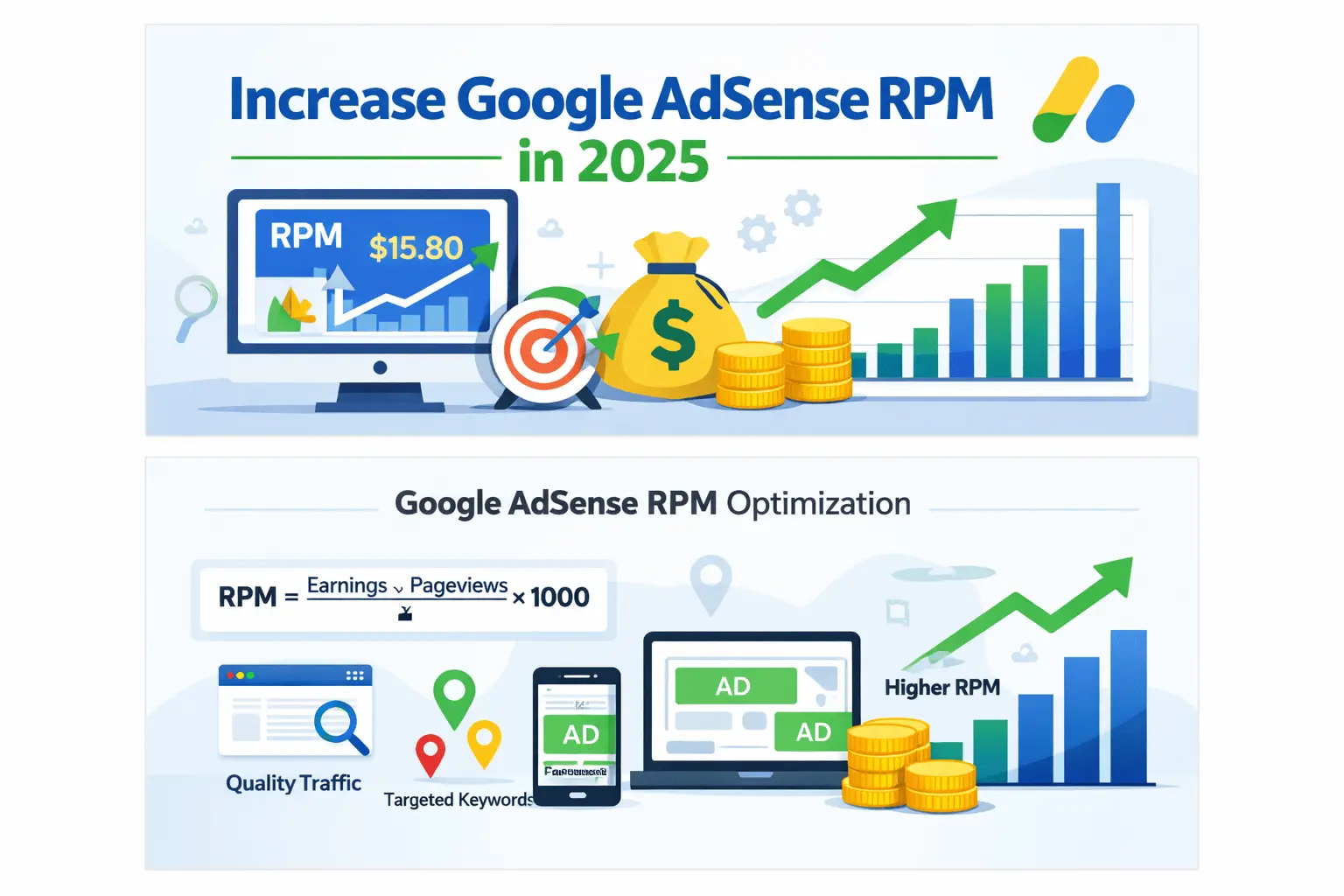
Google defines page RPM as estimated earnings divided by pageviews, multiplied by one thousand. It describes the activity in the selected report period. It does not establish the future earning rate of a niche or article.
Page RPM = estimated earnings ÷ AdSense pageviews × 1,000. If a report contains $6 of estimated earnings and 3,000 pageviews, the calculated page RPM is $2.
Review the official Page RPM definition and our earnings per 1,000 views guide. Use the same date range, filters and currency for earnings and pageviews.
An advertiser keyword estimate is not publisher page RPM. CPC, search demand and organic competition answer different questions. Our CPC, RPM and CTR guide explains the metric distinctions.
Twelve Article Ideas to Investigate
The ideas below are editorial examples, not a ranking of verified high-RPM topics. Each connects a reader question with evidence a publisher could create. Choose only subjects you can cover accurately and that belong on your website.
| Article idea | Reader task | Original evidence to produce |
|---|---|---|
| Compare two tools for one defined workflow | Choose a suitable tool | A consistent task test and documented limitations |
| Build a simple spreadsheet tracker | Organise recurring information | A working practice file and checked examples |
| Troubleshoot a WordPress setup problem | Find and correct an implementation issue | Reproduction steps and before-and-after checks |
| Evaluate hosting for a small website | Understand requirements and trade-offs | A workload-based checklist and dated plan facts |
| Compare remote-work schedules | Select a workable arrangement | Time-zone examples and an availability worksheet |
| Prepare a role-specific portfolio | Demonstrate ability to an employer or client | Original samples and review criteria |
| Evaluate a professional course | Check fit before spending time or money | Current requirements, syllabus review and alternatives |
| Test an AI-assisted workflow | Understand useful outputs and failure cases | Recorded inputs, outputs and human corrections |
| Create a small-business content plan | Organise publishing and approval | A fictional brief and usable planning template |
| Diagnose an analytics discrepancy | Understand why reports differ | Definitions, report settings and a worked example |
| Prepare an ecommerce product catalogue | Structure product information accurately | A fictional catalogue and validation checklist |
| Plan a blog’s recurring operating costs | Budget for publishing and maintenance | A clearly labelled cost worksheet and assumptions |
How to Develop These Ideas into Useful Articles
Software Comparisons with a Defined Use Case
A comparison becomes more useful when it identifies a particular user and task. Instead of “best software,” compare tools for managing a small team’s weekly work or organising client enquiries. Define the testing conditions before selecting a winner.
Record the features tested, account tier, relevant limits and review date. Separate firsthand observations from documentation-only information. Do not claim that you tested a product when you only read its marketing page.
Technical Tutorials You Can Reproduce
Technical tutorials allow a publisher to demonstrate a working process. A strong article identifies prerequisites, shows the actual steps and explains how readers can verify the result. It also records meaningful limitations.
Our WordPress–AdSense connection guide is an example of a specific implementation question. Similar tutorials should address distinct tasks rather than reproduce the same setup with a slightly different title.
Career Content that Helps Readers Act
A career article should explain eligibility, task requirements and a practical next step. A portfolio worksheet or schedule comparison can provide independent value. Avoid treating a role category as proof of current vacancies.
When using salary information, identify its date and scope. A national occupational median is not an individual employer’s offer. Our job-blog AdSense strategy discusses the publishing and monetisation decisions specific to this content.
Education and Course Evaluation
Help a reader understand prerequisites, learning outcomes and the commitment required. Compare a course with the skill the reader needs rather than repeating promotional claims. Check whether any certification or admission details have changed.
Distinguish access to education from guaranteed employment. An article can explain a syllabus and assessment process without predicting that every graduate will receive a salary increase.
AI and Business Workflow Tests
Choose a specific task and show where the workflow succeeds or fails. Record the inputs, relevant tool version or model and checking process. Explain what remained manual and what information should not be uploaded.
A fictional client brief can make the example reproducible without exposing private data. Label it honestly. A polished output alone does not prove that the workflow is accurate, reliable or profitable.
Local Publishing and Operating-Cost Guides
Local context can make a general question more useful. Explain the actual audience, available services and relevant constraints rather than adding a country name to generic advice. Date prices and clarify which costs are optional.
For example, our blogging in Bangladesh guide serves a location-specific audience. A supporting cost article would need a distinct calculation and current assumptions, not another copy of the entire beginner roadmap.
Treat Finance, Health and Legal Subjects Differently
Do not enter a specialist subject simply because a keyword tool displays a large advertising bid. Content about health, financial stability or legal decisions can affect important parts of readers’ lives. It needs appropriate expertise, reliable sources and careful maintenance.
Google’s people-first content guidance discusses trust and expertise for consequential topics. An author biography or disclaimer does not substitute for accurate work.
If you lack the necessary knowledge, choose a topic you can demonstrate competently or involve a suitably qualified reviewer. Do not publish personalised advice or invented recommendations to fill a profitable-looking category.
A Six-Question Topic Selection Framework
Use the questions below to compare ideas before production. This is an editorial planning method, not a Google ranking formula or a model that predicts RPM.
- Audience fit: Would your existing or intended readers benefit from this answer?
- Distinct intent: Does it solve a question not already answered by an existing page?
- Evidence: Can you produce a useful test, example, calculation or original explanation?
- Demand: What evidence suggests people need the answer?
- Feasibility: Can you research, verify and maintain it within your resources?
- Measurement: What reader outcome and available reports will you review after publication?
Reject or defer an idea when a critical answer is missing. Strong advertising potential does not compensate for the inability to research the subject. Likewise, an interesting question may belong in an existing article rather than a new URL.
Use Demand Signals Carefully
Existing Search Console queries can reveal questions associated with your site. They are useful starting evidence, but impressions are not total market search volume. A low impression count can reflect limited visibility as well as limited demand.
Reader questions, support conversations and relevant community discussions can also reveal unmet needs. Look for a recurring problem and a clear answer you can improve. Do not manufacture demand from one isolated comment.
Keyword tools can provide further context, but their estimates and competition measures need interpretation. Advertiser competition is not the same as organic ranking difficulty. A more specific phrase is not automatically easy to rank.
Use our AdSense keyword-research guide for the research process. Keep the topic decision grounded in the reader’s task rather than choosing whichever row has the largest CPC.
Write a Brief Before Writing the Article
A short brief can expose a weak idea before you spend hours drafting. Define the target reader, the result they need and the evidence required. Identify changing facts and the sources you will consult.
Proposed article:
Target reader:
Main question:
Expected reader outcome:
Existing page that may overlap:
Original evidence to create:
Primary sources to verify:
Limits of the article:
Relevant next-step resource:
Maintenance trigger:
Available measurement:
A comparison needs test criteria. A tutorial needs prerequisites and verification. A calculation needs inputs and assumptions. A review needs enough evidence to justify its conclusions. The format should follow the task.
Illustrative Topic-Selection Example
Imagine a publisher with experience maintaining small WordPress sites. The following example demonstrates editorial reasoning only. It is not a BlogerHub earnings case study.
| Candidate | Evidence available | Decision |
|---|---|---|
| Best insurance policy for every reader | No relevant specialist expertise | Defer; the apparent advertising opportunity does not resolve the expertise gap |
| Why a WordPress script is missing after a theme change | A reproducible practice site and implementation knowledge | Investigate demand and prepare a troubleshooting brief |
| Another general guide to starting a blog | An existing page already covers the same task | Improve the existing resource if useful information is missing |
The selected technical idea is more feasible to document. That does not establish a higher future RPM. It gives the publisher a stronger basis for producing a useful article and measuring its actual result.
Compare Results After Publication
First confirm that the page is accessible and internally linked. Monitor search discovery separately from monetisation. An article with no visitors cannot provide useful evidence about its advertising performance.
Use supported page-level earnings data where available. Otherwise, compare valid broader reports and clearly state that you cannot attribute revenue to individual URLs. Do not invent an article’s RPM by assigning sitewide earnings according to its Analytics traffic share.
Compare complete periods and note device, geography and source differences. Our earnings seasonality guide explains another factor that can complicate before-and-after conclusions.
Small samples can produce unstable RPM. An article with a few visits and unusually high earnings is a candidate for further observation, not proof that an entire subject category is more profitable.
A Higher RPM Can Still Produce Less Revenue
Evaluate total earnings alongside RPM. The following figures are fictional and show the arithmetic only; they are not typical rates for any topic or country.
| Illustrative topic group | AdSense pageviews | Page RPM | Estimated earnings |
|---|---|---|---|
| Group A | 1,000 | $8 | $8 |
| Group B | 10,000 | $2 | $20 |
Group A has the higher RPM, while Group B generates more estimated revenue in the example. Neither figure measures profit. Research, testing, maintenance and other costs still matter.
When combining groups, add matching earnings and pageviews before calculating the combined RPM. Do not take the simple average of unequal groups’ RPM values.
Improve Monetisation Without Changing the Topic’s Purpose
A useful article needs readable text, working resources and a clear next step. Advertising should not disguise navigation, obscure instructions or cause accidental taps. Topic selection and ad implementation are separate responsibilities.
Review our AdSense placement guide when checking layouts. Do not add unnecessary sections merely to create more advertising positions.
For limited traffic, use the low-traffic optimisation workflow. More ad units or a new subject category cannot resolve every measurement or implementation problem.
Avoid Topic-Selection Myths
There is no universal RPM range attached to finance, software or education. Country-based averages from another website do not predict your results. Treat screenshots and anecdotal claims as context that needs verification.
There is also no article count that guarantees an earning level. Publishing fifty or one hundred pages without distinct value can create a maintenance burden. Publish when you have a useful resource ready, rather than following an arbitrary quota.
Google says it does not have a preferred word count. A concise answer can be complete, while a long page can repeat itself. Choose the length needed to explain the question, evidence and limitations.
Do not switch your whole site to an unrelated category after one high-CPC estimate. Evaluate audience fit, expertise and existing content first. Avoid creating multiple new pages that compete to answer the same reader question.
A Practical Editorial Review Cycle
| Stage | Action | Output |
|---|---|---|
| Discover | Collect relevant reader questions and search signals | A shortlist with supporting notes |
| Evaluate | Check fit, overlap, evidence and maintenance effort | A keep, defer or improve-existing decision |
| Produce | Create the original evidence and verify changing facts | A complete article with clear limitations |
| Review | Inspect discovery, reader outcomes and available earnings data | A measured next action |
Do not force a revenue conclusion by a fixed deadline. Some pages need more activity before comparison becomes useful. Others may need a clearer answer or better discovery before monetisation can be assessed.
Keep successful resources current and record inconclusive results. Your editorial system becomes stronger when it explains why you selected, improved or deferred a topic, rather than repeatedly chasing a supposed high-paying list.
Frequently Asked Questions
Which blog topic guarantees the highest AdSense RPM?
None. Your actual results depend on the audience, advertising activity and implementation. Choose useful topics you can cover accurately, then measure their performance.
Should beginners choose finance or legal topics?
Only when they can provide appropriately accurate and expert coverage. A promising advertising estimate is not a substitute for the knowledge required. Many publishers have stronger evidence in their existing area of experience.
Are product comparisons automatically more profitable?
No. They need a relevant audience and credible evaluation. Explain your testing and limitations, and distinguish documentation-based observations from firsthand results.
How many articles should I publish before measuring?
There is no universal count. Measurement depends on actual activity and report availability. Maintain complete, distinct resources rather than expanding the site solely to reach a number.
Does adding USA to a title increase RPM?
No. The article must serve a genuine location-specific need, and the title does not change who visits. Use real audience and earnings data rather than assuming a geographical label improves revenue.
What should I do if a promising topic earns little?
Check whether there is enough data, whether ads are implemented correctly and whether the page serves its audience. Assess total revenue and production effort. Improve or defer based on evidence rather than replacing it with another unsupported prediction.