Remote Jobs Guide for Beginners: Work From Home Safely
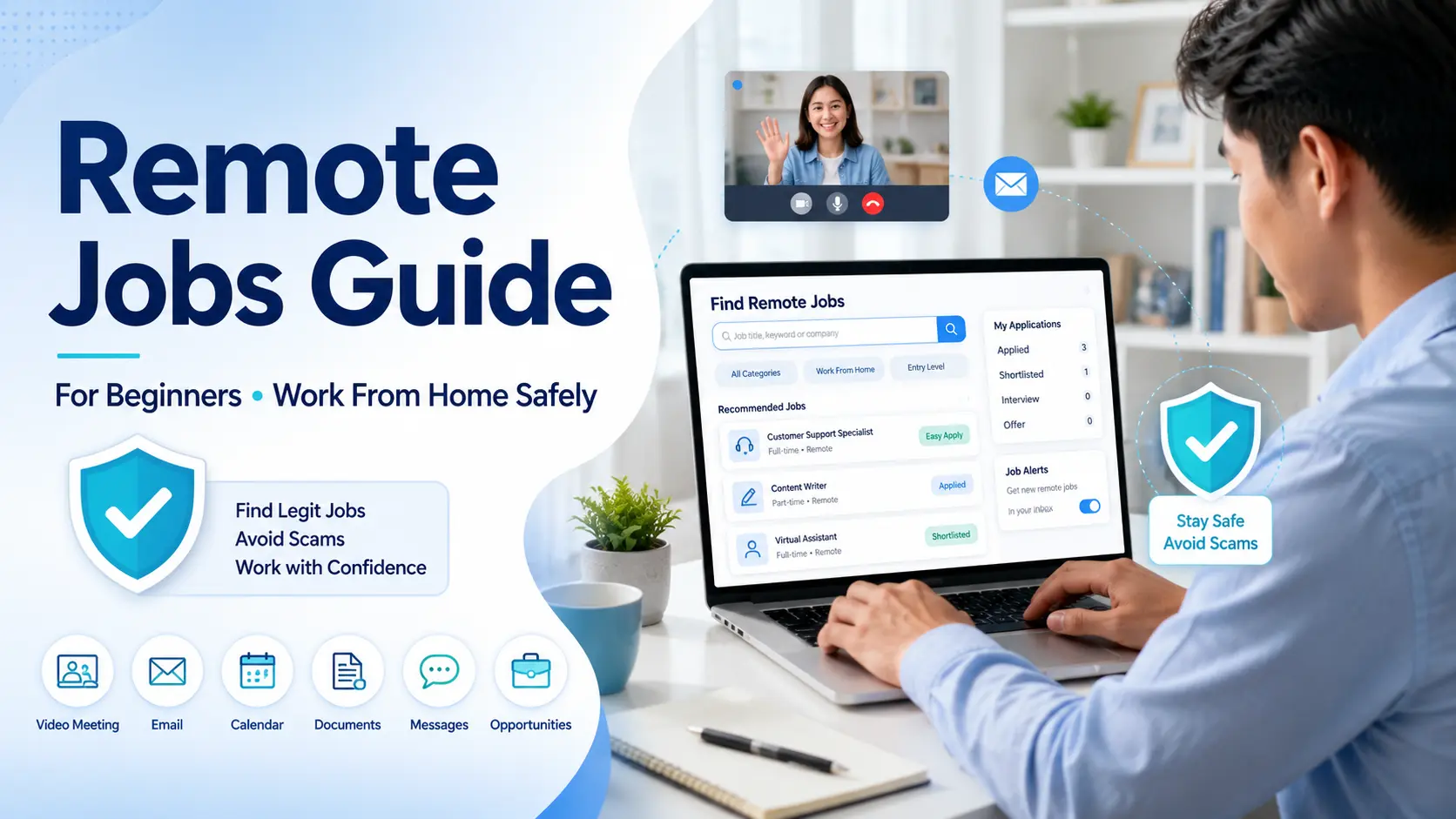
Remote work can give you access to employers and clients beyond your local area, but finding a legitimate position requires more than searching for “work from home jobs.” You need to choose a realistic role, prove the right skills, confirm where the employer can hire, tailor each application, and verify the company before sharing sensitive information.
This remote jobs guide is the main BlogerHub roadmap for beginners in Bangladesh and the USA. It connects you to detailed guides for entry-level roles, no-degree opportunities, remote job boards, data entry, jobs with limited phone work, and scam prevention.
If you want independent project work rather than an employee position, compare the differences in our freelancing USA guide. Remote employment and freelancing can both happen online, but the hiring process, taxes, benefits, control, and income stability may be different.
Remote Jobs Guide: Quick Answer
To start a remote-job search, choose one role family, study several real job descriptions, learn the recurring tools, create a targeted resume and one or two relevant work samples, and apply through established job boards or official company career pages. Check the listing’s country, state, time-zone, work-authorization, schedule, and equipment requirements before applying. Never pay to receive a job, deposit a check and return money, buy gift cards for an employer, or accept package-reshipping work.
Your first goal is not to apply for every remote vacancy. It is to become a credible candidate for one defined type of work.

Choose the Right Remote Job Guide
Start with the resource that matches your location and immediate goal.
| Your situation | Best next guide | What it covers |
|---|---|---|
| You live in Bangladesh | Remote jobs in Bangladesh | International eligibility, skills, schedules, payment, and local considerations |
| You are new to remote work in the USA | Remote jobs for beginners USA | Entry-level role ideas and preparation |
| You do not have a four-year degree | Remote jobs without a degree | Skills-first roles and proof employers may expect |
| You need places to search | Best remote job boards | Platform comparison, filters, pricing, and limitations |
| You prefer structured spreadsheet work | Remote data entry jobs USA | Real tasks, required skills, and scam risks |
| You prefer written communication | Remote jobs without phone calls | Chat, email, content, research, and back-office roles |
| You want to verify an opportunity | Remote job scam warnings | Fake recruiters, checks, fees, reshipping, and identity theft |
Understand What “Remote” Really Means
A remote listing does not always mean “work from anywhere.” An employer may restrict hiring because of payroll registration, taxes, employment law, client contracts, data access, licensing, or required working hours. A role can be remote within one US state, remote anywhere in the USA, limited to a group of countries, or globally distributed.
- Fully remote: work is normally performed away from a company office.
- Hybrid: some office attendance is required.
- Remote-first: processes are designed primarily for distributed workers, though offices may exist.
- Temporary remote: the role may later return to an office.
- Location-limited remote: you can work from home only within approved states or countries.
Also check whether the position is employment or independent contracting. An employee may receive payroll withholding and employer benefits, while a contractor generally runs an independent business and handles more of their own records and taxes. A company cannot settle classification merely by putting “contractor” in an agreement; the real working relationship and applicable law matter. If the status is unclear, ask before accepting the offer.
Beginner-Friendly Remote Job Categories
No role is automatically easy, and entry-level does not mean no skills are required. Use this comparison to identify a plausible starting point.
| Role family | Typical deliverables | Useful proof sample | Communication pattern |
|---|---|---|---|
| Data entry and operations | Accurate records, cleaned spreadsheets, database updates | Before-and-after spreadsheet | Mostly written; meetings vary |
| Virtual assistance | Schedules, research, inboxes, documents | Sample calendar and research brief | Email, chat, and meetings |
| Customer support | Resolved tickets and documented customer issues | Sample support replies | Phone, chat, or email depending on role |
| Content support | Edited articles, briefs, product copy, CMS updates | Two polished writing or editing samples | Mainly written plus reviews |
| Social media support | Content calendars, captions, scheduling, reports | One-week sample calendar | Written and occasional meetings |
| Product listing | Accurate titles, attributes, images, and categories | Sample catalog sheet | Mostly written |
| Online research | Verified findings with organized sources | Short sourced research brief | Mostly written |
| WordPress support | Formatted posts, media, links, and basic updates | Demo post or test site | Written plus task reviews |
| QA and testing support | Reproducible bug reports and test results | Sample bug report | Written and team meetings |
Choose based on evidence you can build, not only the job title. For example, “virtual assistant” can mean scheduling and email for one employer but sales calls and bookkeeping for another. The job description is the real definition.
A 7-Step Remote Job Roadmap
1. Select One Role Family
Consider your current skills, English level, device, internet reliability, available working hours, time zone, and comfort with calls. Save 15 to 20 real listings for one role. Record the skills, tools, experience, schedule, and location requirements that repeat. This gives you a market-based learning list.
2. Learn the Recurring Tools
Most remote workers need professional email, document and spreadsheet basics, file organization, video meetings, calendar use, task tracking, and safe account practices. Then add tools specific to your role. A support candidate might practice a ticket workflow; a content assistant might learn WordPress formatting; a data candidate might practice spreadsheet validation and cleanup.
3. Build Evidence Before You Apply
If you lack paid experience, create a small simulation that resembles the job’s output. Remove invented clients and label it clearly as a sample project. A strong sample shows the starting information, your process, the finished deliverable, and a short explanation of quality checks.
- Data entry: clean a deliberately messy spreadsheet and document the validation rules.
- Customer support: write responses to five sample customer scenarios.
- Research: prepare a one-page brief with links, dates, and source notes.
- WordPress: format a demo article with headings, links, images, alt text, and a table.
- QA: report a reproducible website bug with steps, expected behavior, actual behavior, and evidence.
4. Create a Targeted Resume
Use a simple layout that is easy to scan. Include a role-specific summary, relevant skills, experience, selected projects, education, and certifications where useful. Mirror accurate terminology from the listing, but do not copy sentences or add tools you cannot use. Describe results with context when you have real evidence.
Remote work itself is not a skill. Show behaviors such as documenting decisions, meeting deadlines, coordinating across teams, handling confidential information, solving problems independently, and communicating progress.
5. Search with Precise Filters
Search established job boards, professional networks, staffing firms, and official company career pages. Combine the role with terms such as “remote,” “entry level,” “junior,” or a required tool. Then filter by country, state, employment type, experience, schedule, and posting date. Our remote job boards comparison can help you choose a manageable set of sources.
6. Tailor and Track Applications
Apply when you meet the core responsibilities even if you do not match every preferred qualification. Adjust your summary and leading evidence to the vacancy. In a short cover message, name the role, connect your experience or sample to a key requirement, and explain the value you can provide.
Track the company, role, source, URL, date, resume version, contact, status, and follow-up date. This prevents duplicate applications and helps you discover patterns. If many relevant applications receive no response, review your targeting and resume. If interviews do not become offers, practice role-specific answers and improve your evidence.
7. Verify the Interview and Offer
Before an interview, confirm that the opening exists on the company’s official site when possible. Check the recruiter’s identity and email domain independently. During the interview, ask about responsibilities, manager, schedule, time zone, performance measures, communication routines, equipment, pay frequency, employment type, and next steps.
A written offer should identify the employer, role, compensation, classification, start date, schedule, location rules, and relevant conditions. Do not resign from another job or buy equipment based only on a chat message.
How to Evaluate a Remote Job Listing
| Check | What to confirm | Why it matters |
|---|---|---|
| Location | Approved country or state and work authorization | “Remote” may still be geographically restricted |
| Schedule | Fixed hours, shifts, overlap, weekends, or flexibility | The role must fit your actual availability and time zone |
| Employment type | Employee, temporary worker, or contractor | Affects control, records, benefits, and tax handling |
| Responsibilities | Specific tasks and expected outcomes | Vague duties can hide a mismatch or scam |
| Compensation | Rate or salary, currency, pay cycle, and method | Lets you compare the complete offer |
| Equipment | Who supplies devices, software, and support | Fake-check scams often misuse equipment purchases |
| Privacy | When and why sensitive details are required | Limits unnecessary identity exposure |
| Company identity | Official website, career page, staff, and contact domain | Helps detect impersonation |
Remote Job Scam Warning Signs
Scammers advertise on job sites and social media alongside legitimate employers. The US Federal Trade Commission warns about work-from-home schemes, fake checks, reshipping, and recruiters who want money or personal information rather than hiring you.
- You must pay a registration, activation, training, certification, security, or equipment fee to get the job.
- The employer sends a check and tells you to buy equipment, gift cards, or return part of the money.
- Your “job” is to receive and reship packages or move money through your account.
- You receive an offer without a credible interview or skills review.
- The recruiter uses an unrelated personal email address or a look-alike domain.
- The pay is unusually high for vague, simple work, with pressure to act immediately.
- You are asked for passwords, PINs, one-time codes, or unnecessary identity documents.
- The company, recruiter, address, and vacancy cannot be verified independently.
Search the company or recruiter name with words such as “scam,” “review,” or “complaint,” but remember that no complaints do not prove legitimacy. Contact the company using details you found independently—not a number supplied only in the suspicious message. Read the complete remote job scam guide before accepting an unfamiliar offer.
A Practical 30-Day Remote Job Plan
| Period | Main objective | Output |
|---|---|---|
| Days 1–7 | Choose one role and analyze real listings | Skill-and-requirement checklist from 15–20 jobs |
| Days 8–14 | Practice the top tools and task workflow | One completed role-specific exercise |
| Days 15–18 | Create proof and improve your professional profile | One or two samples plus a targeted profile |
| Days 19–21 | Prepare application materials | Resume, base cover message, and tracking sheet |
| Days 22–30 | Apply selectively and practice interviews | Relevant applications, follow-ups, and revised answers |
Quality matters more than a universal daily application target. Review results weekly. Change one element at a time—role targeting, resume evidence, sample quality, or interview preparation—so you can tell what improves.
Remote Work Setup and Professional Habits
- Use a stable internet connection and make a realistic backup plan.
- Create a quiet, safe workspace suitable for the role’s privacy needs.
- Keep your operating system, browser, and security tools updated.
- Use unique passwords and multi-factor authentication.
- Confirm priorities, deadlines, owners, and the definition of “done” in writing.
- Report progress and blockers before a deadline is at risk.
- Do not move employer or customer data into personal tools without permission.
- Keep agreements, pay records, invoices, and work-related expense records.
Tax and employment obligations depend on your country, state, classification, and facts. US employees and independent contractors may have different reporting and withholding arrangements; international workers must consider their own local requirements. Use official tax guidance or a qualified professional for your situation rather than relying on a job post.
FAQ About Remote Jobs
Can I get a remote job from Bangladesh?
Yes, some companies and clients hire eligible workers in Bangladesh, but not every remote vacancy is global. Check the approved countries, employment or contractor status, working-hour overlap, English requirements, payment method, and local legal or tax obligations. Start with the Bangladesh remote jobs guide.
Which remote jobs are realistic for beginners?
Possible starting categories include customer support, data operations, virtual assistance, product listing, research, content support, social media assistance, WordPress support, and junior QA. Suitability depends on the actual tasks and your evidence, not the title alone.
Can I get a remote job without a degree?
Some employers prioritize relevant skills, experience, portfolios, and reliability, while regulated or specialized positions may require education, licensing, or certification. Read the requirements carefully and use the no-degree remote jobs guide to identify skills-first options.
Where should I search for legitimate remote jobs?
Use established job boards, professional networks, reputable staffing firms, and official company career pages. A platform can host both genuine and fraudulent listings, so verify the employer independently before accepting an offer.
Are remote data-entry jobs real?
Legitimate data-entry and data-operations roles exist, but vague “simple typing” offers with unusually high pay are frequently used in scams. A credible listing should explain the employer, records, workflow, accuracy expectations, schedule, tools, and compensation without demanding money.
Can a remote job have no phone calls?
Some roles rely mainly on email, chat, documents, tickets, or project systems. However, “no phone” does not necessarily mean no communication; interviews, onboarding, training, or team meetings may still use video or voice. Confirm the actual communication requirements.
Should I pay for remote-job training or equipment?
Do not pay a recruiter or employer for the promise of a job. Be especially careful if someone sends a check and asks you to buy equipment or return money; the check can appear available before it is discovered to be fake. Independently verify any equipment process through the company’s official contact channel.
How long does it take to get a remote job?
There is no reliable universal timeline. It depends on role demand, location eligibility, experience, evidence, application quality, competition, and hiring speed. Measure progress through relevant applications, response rate, interviews, and feedback rather than assuming a guaranteed deadline.
Your Next Step
Use this remote jobs guide as your cluster roadmap: choose the child guide that fits your location or target role, study real vacancies, build one proof sample, prepare a targeted resume, and verify every employer. If you are in Bangladesh, continue with remote jobs in Bangladesh. US beginners can start with beginner-friendly remote jobs.
If your main goal is broader online income rather than employment, explore the Make Money Online USA hub. Keep the paths separate: remote employment means applying for a role, while freelancing and side hustles involve selling services or building an independent income activity.