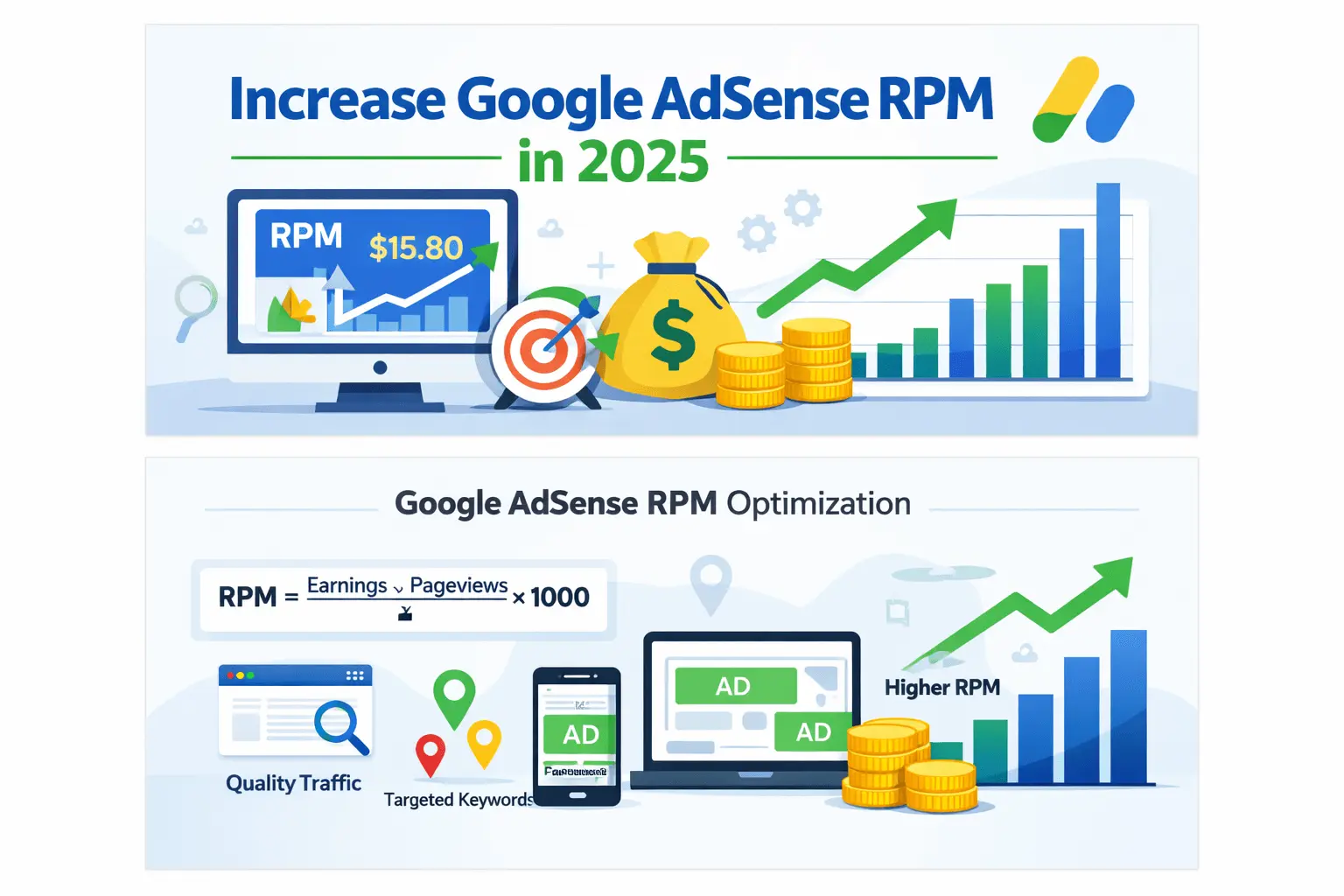


To make $10 per day with Google AdSense, you would need about 500 pageviews at a $20 page RPM, 1,000 pageviews at a $10 RPM, 2,000 pageviews at a $5 RPM, or 5,000 pageviews at a $2 RPM. Use this formula: required pageviews = target earnings ÷ page RPM × 1,000. These are estimates, not guaranteed earnings, because RPM changes with your audience, content, ad demand, season, device mix, and ad setup.
Quick Answer: Pageviews Needed to Make $10 a Day
| Estimated page RPM | Daily pageviews for $10 | Approximate monthly pageviews |
|---|---|---|
| $1 | 10,000 | 300,000 |
| $2 | 5,000 | 150,000 |
| $5 | 2,000 | 60,000 |
| $8 | 1,250 | 37,500 |
| $10 | 1,000 | 30,000 |
| $15 | 667 | 20,010 |
| $20 | 500 | 15,000 |
The table uses page RPM, not CPC. Actual daily results may be higher or lower, and estimated earnings can later be adjusted. If you already use AdSense, your own 28-day or 90-day page RPM is more useful than a generic online benchmark.
What Is AdSense Page RPM?
Page RPM means estimated revenue per 1,000 pageviews. Google defines page RPM as estimated earnings divided by pageviews, multiplied by 1,000. RPM is a reporting metric; it does not promise that every 1,000 future views will produce the same revenue. You can read Google’s official page RPM definition.
Page RPM = (estimated earnings ÷ pageviews) × 1,000
For example, if a site earns an estimated $40 from 8,000 pageviews, its page RPM is ($40 ÷ 8,000) × 1,000 = $5. At the same RPM, the mathematical estimate for $10 is 2,000 pageviews.
Page RPM vs. CPC
CPC is the amount associated with an individual ad click, while page RPM estimates total earnings per 1,000 pageviews. A page can produce revenue through different ad interactions and campaign types, so page RPM is the more practical metric for estimating the traffic needed to reach a daily revenue target. If you want a broader explanation, see our guide to AdSense earnings per 1,000 views.
How to Calculate Your Required Traffic
Reverse the page RPM formula to estimate the pageviews required for a chosen income target:
Required daily pageviews = (daily earnings target ÷ page RPM) × 1,000
If your average page RPM is $4.50, the estimate is ($10 ÷ $4.50) × 1,000 = approximately 2,222 pageviews per day. For a $7.25 page RPM, the estimate is approximately 1,379 pageviews.
Use Your Own AdSense Data
- Open your AdSense reporting dashboard.
- Select a meaningful period, such as the last 28 or 90 days.
- Find your website’s page RPM for that period.
- Insert that RPM into the formula above.
- Repeat the calculation with a lower and higher RPM to create a realistic range.
A longer date range reduces the effect of a single unusually strong or weak day. However, it cannot remove future changes in seasonality, advertiser demand, traffic mix, or content performance.
Pageviews Are Not the Same as Visitors or Sessions
A user may view more than one page during a visit. That means 2,000 daily pageviews do not necessarily require 2,000 different people. If the average visitor views 1.4 pages, 2,000 pageviews would represent roughly 1,429 visits or users under a simplified assumption. Analytics tools define users and sessions differently, so use pageviews when applying a page RPM calculation.
Do not inflate pageviews with forced refreshes, misleading navigation, bots, or artificial activity. The goal is genuine readership and useful engagement, not a larger counter.
Why AdSense RPM Changes
Google states that earnings depend on factors such as traffic volume, content type, user location, and ad setup. Your observed page RPM can therefore change from one day, page, or audience segment to another.
- Visitor location: Advertiser competition and commercial demand vary by market.
- Content topic and intent: A visitor researching a high-value service may attract different demand from someone reading a general informational page.
- Season and advertiser budgets: Demand can rise or fall during the year.
- Device and layout: Mobile and desktop experiences can produce different viewability and engagement patterns.
- Ad formats and placement: Visibility matters, but ads must not interfere with content or cause accidental clicks.
- Traffic quality: Genuine, interested users are fundamentally different from automated or incentivized activity.
- Individual page performance: Sitewide averages can hide large differences between articles.
No country, niche, or ad position guarantees a fixed RPM. Treat public RPM lists as rough context, not a forecast. For additional comparisons, read our guides to AdSense RPM by country and AdSense niches in the USA.
Hypothetical Bangladesh and US Traffic Examples
The following examples demonstrate the formula. They are not country-level RPM claims.
Example 1: A Bangladesh-Focused Blog
Suppose a Bangla-language education blog checks its own AdSense report and sees a 90-day page RPM of $1.80. Its mathematical estimate for $10 per day is ($10 ÷ $1.80) × 1,000 = about 5,556 daily pageviews. If its RPM later becomes $2.50, the estimate falls to 4,000 pageviews. The site’s real dashboard—not the country label—provides the input.
Example 2: A US-Focused Blog
Suppose a site serving mostly US readers records a 90-day page RPM of $12. Its estimate is ($10 ÷ $12) × 1,000 = about 834 daily pageviews. A different US-focused site may record a much lower or higher RPM because its content, audience, season, and ad performance are different. See our separate overview of Google AdSense earnings in the USA for more context.
Is $10 a Day the Same as $300 a Month?
Mathematically, $10 multiplied by 30 days equals $300. In practice, traffic and RPM rarely stay identical every day. A site may earn $6 one day and $14 another. It is better to evaluate a monthly average than to expect exactly $10 every day.
To estimate monthly traffic, use: monthly pageviews = (monthly earnings target ÷ page RPM) × 1,000. At a $5 page RPM, a $300 monthly target corresponds to approximately 60,000 pageviews. At a $10 page RPM, it corresponds to approximately 30,000 pageviews.
How to Improve Revenue Safely
You cannot control every auction or advertiser budget, but you can improve the website and the usefulness of its content. Focus on sustainable changes instead of chasing a promised RPM.
- Answer a specific reader need. Create original, accurate content that solves the question promised by the title.
- Improve pages already receiving impressions. Use Search Console data to strengthen unclear sections, titles, and internal links.
- Make the site fast and usable. Check mobile readability, Core Web Vitals, navigation, and intrusive elements.
- Build useful topic clusters. Link closely related articles so readers can continue to relevant information naturally.
- Review ad implementation. Ads should be viewable without covering content or encouraging accidental interaction.
- Compare meaningful segments. Review performance by page, country, device, and traffic source instead of relying only on a sitewide average.
- Test carefully. Change one major element at a time and compare a sufficient date range.
For practical optimization ideas, see our guide to improving AdSense RPM and CPC. Optimization should preserve user experience and comply with Google policies.
Invalid Traffic and Accidental Clicks
Google defines invalid traffic as clicks or impressions that may artificially inflate advertiser costs or publisher earnings. Examples include clicking your own live ads, repeated artificial activity, encouraging people to click ads, automated tools, robots, and deceptive software. High levels of invalid traffic can lead to limited ad serving, suspension, or account closure. Review Google’s official invalid traffic guidance.
- Never click your own live ads.
- Do not ask friends, employees, or readers to click ads.
- Do not use bots, traffic exchanges, auto-refresh tools, or incentivized traffic.
- Be cautious with purchased traffic and monitor every source closely.
- Keep ads away from buttons, menus, and layouts that can cause accidental clicks.
- Investigate unusual traffic spikes and block suspicious sources when possible.
Does AdSense Require Minimum Traffic for Approval?
Google’s published AdSense eligibility guidance does not state a universal minimum pageview number for a standard website application. Approval and earnings are separate questions: a site still needs eligible, policy-compliant content and a good user experience. Review our full guide to Google AdSense approval requirements for new blogs before applying.
Frequently Asked Questions
How many pageviews are needed to earn $10 a day?
It depends on your page RPM. The estimate is 10,000 pageviews at a $1 RPM, 2,000 at a $5 RPM, 1,000 at a $10 RPM, or 500 at a $20 RPM. None of these outcomes is guaranteed.
How do I calculate traffic from page RPM?
Divide your target earnings by your page RPM, then multiply by 1,000. For a $10 target and a $6 RPM, the estimate is ($10 ÷ $6) × 1,000 = approximately 1,667 pageviews.
Can 500 pageviews make $10 with AdSense?
Mathematically, 500 pageviews would produce an estimated $10 at a $20 page RPM. Your actual RPM may be lower or higher, so 500 views alone cannot guarantee $10.
Is $10 per day guaranteed at a specific traffic level?
No. AdSense earnings vary with traffic, content, visitor location, ad setup, advertiser demand, and other factors. The formula is an estimate based on an assumed RPM.
Are pageviews and visitors the same?
No. One visitor can open multiple pages, while pageviews count each qualifying page load reported by your analytics system. Use pageviews for a page RPM calculation.
Does AdSense require minimum traffic for approval?
Google does not publish a universal minimum traffic threshold in its standard eligibility guidance. A site must still satisfy eligibility, content, ownership, user-experience, and policy requirements.
Can traffic from Bangladesh earn $10 per day?
Yes, genuine visitors from Bangladesh can generate AdSense revenue, but there is no fixed country RPM or guaranteed pageview requirement. Use the site’s actual page RPM to estimate the traffic needed.
Can purchased traffic increase AdSense earnings?
Paid promotion is not automatically the same as invalid traffic, but publishers are responsible for traffic quality. Never use bots, traffic exchanges, incentivized clicks, deceptive providers, or any source that artificially generates impressions or clicks. Monitor paid sources carefully and follow Google’s traffic-quality policies.
Earnings Disclaimer
All RPM values, pageview totals, country scenarios, and income calculations in this article are educational examples. They are not income promises or predictions. AdSense reports show estimated earnings, and actual results vary. Always rely on your own current reports and Google’s official policies.
Final Takeaway
The amount of traffic needed to make $10 per day from AdSense is determined by your actual page RPM. At a $2 RPM, the estimate is 5,000 daily pageviews; at $5, it is 2,000; at $10, it is 1,000; and at $20, it is 500. Use a 28-day or 90-day RPM, calculate a range, and focus on useful content, genuine readers, a good site experience, and policy-safe growth.