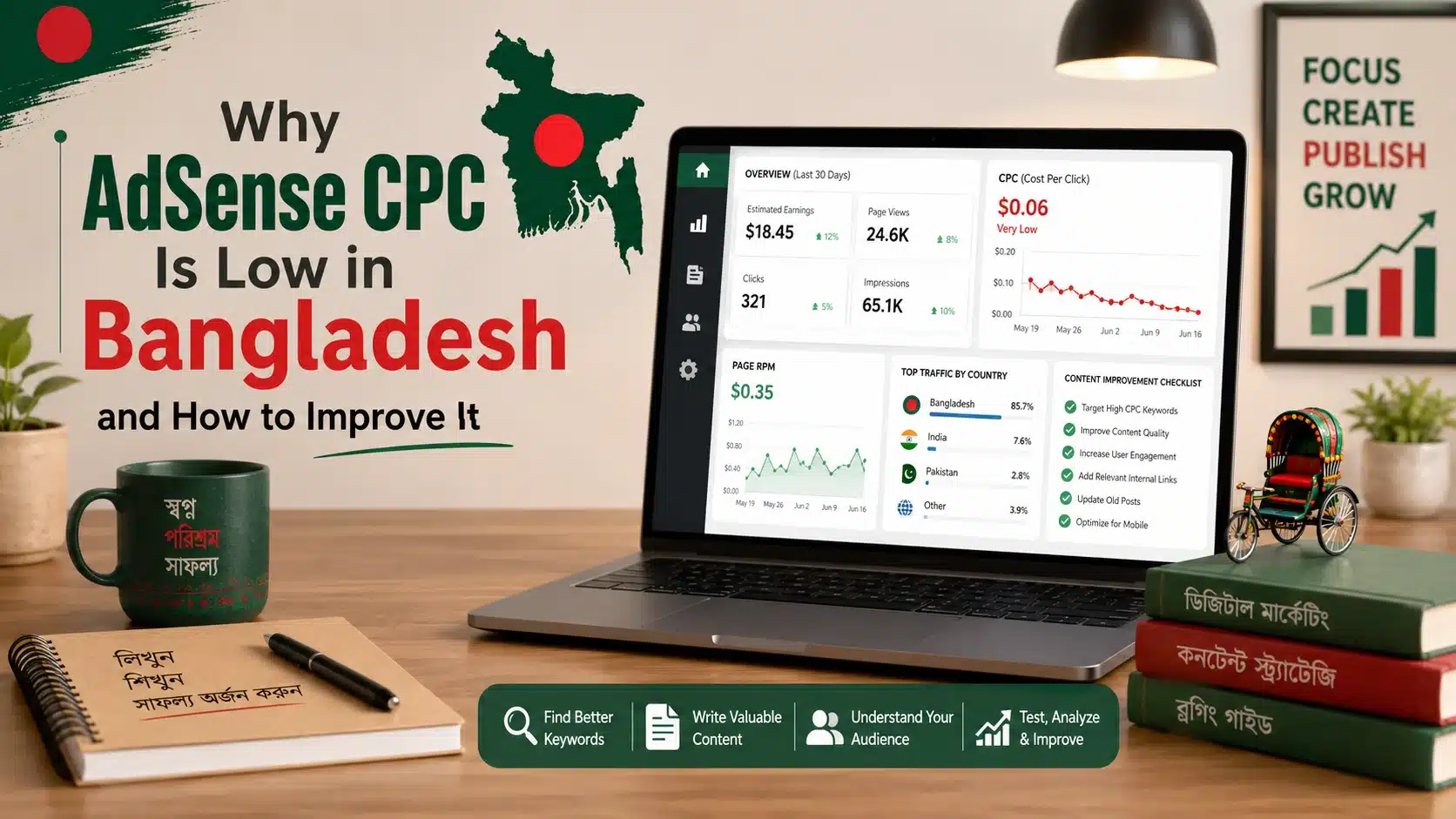

Low AdSense CPC is a common concern for Bangladeshi publishers. However, a low average click value does not automatically mean that a website is failing. Total earnings also depend on pageviews, ad impressions, Page RPM, audience location, content topics, advertiser demand, devices, seasonality, and traffic quality.
This guide explains why AdSense CPC is low in Bangladesh, how CPC differs from Page RPM, which factors publishers can and cannot influence, and how to improve overall AdSense performance without creating invalid-traffic or accidental-click risks.
Last reviewed: July 2026. Advertising demand and account performance change over time. Use your own 7-day and 30-day reports instead of treating a single day or click as a permanent benchmark.
New to website monetization? Start with our Google AdSense guide for beginners.
Why Is AdSense CPC Low in Bangladesh? Quick Answer
AdSense CPC can be lower when advertisers place lower bids for the available audience, topic, location, device, season, or user context. Publishers cannot directly set CPC because the value of each click is determined by advertisers participating in the advertising auction.
Instead of chasing individual clicks, review CPC together with Page RPM, pageviews, countries, devices, traffic sources, and top-earning pages. Improve useful content, genuine traffic, mobile experience, ad viewability, and internal navigation while following AdSense policies.
Understanding CPC, Page CTR, Page RPM and Earnings
CPC, CTR, and Page RPM measure different parts of AdSense performance. Looking at only one metric can create a misleading picture of a website’s earnings.
| Metric | Meaning | Best use |
|---|---|---|
| CPC | The average estimated amount earned from an eligible ad click | Understanding click value |
| Page CTR | The number of ad clicks divided by pageviews | Monitoring click behaviour |
| Page RPM | Estimated earnings per 1,000 pageviews | Comparing overall page monetization |
| Pageviews | The number of pages viewed while ads are available | Measuring monetizable traffic volume |
| Ad impressions | The number of individual ad impressions served | Understanding ad delivery |
| Estimated earnings | A close estimate of recent revenue before final adjustments | Monitoring recent account performance |
How Page RPM Is Calculated
Google calculates Page RPM using this formula:
Page RPM = Estimated earnings ÷ Pageviews × 1,000
For example, if a website earns an estimated $0.27 from 87 pageviews, its Page RPM is approximately $3.10. Small differences may appear because of reporting updates, rounding, or adjustments.
Page RPM is a comparison metric, not a promise that every future 1,000 pageviews will earn the same amount.
Why AdSense CPC Can Be Low in Bangladesh
No single factor determines the CPC of every Bangladeshi website. AdSense uses advertising auctions, and the amount publishers earn varies according to the advertisers, ads, audience, page content, and circumstances available at that time.
| Possible factor | How it may affect performance | Publisher response |
|---|---|---|
| Advertiser demand | Fewer or lower bids may reduce the value of available clicks | Focus on useful topics with genuine audience demand |
| Audience location | Advertising competition differs across markets | Serve your real audience instead of chasing countries blindly |
| Topic and commercial relevance | Some subjects attract more advertiser interest than others | Build relevant, focused topic clusters |
| User context | Device, timing, location, and available ads may differ | Compare reports over longer periods |
| Seasonality | Advertiser budgets can change during the year | Compare similar periods rather than one day |
| Ad format and placement | Different formats can produce different impressions and interactions | Use reports and experiments safely |
| Small data sample | A few clicks can make average CPC change sharply | Review 7-day and 30-day results |
Site speed, internal links, mobile usability, and content depth do not directly set CPC. However, they can influence rankings, engagement, pageviews, ad viewability, and total Page RPM.
Low CPC vs Low Total AdSense Income
Low CPC and low total earnings are related, but they are not the same problem. A website with modest CPC can still earn more when it receives consistent pageviews and maintains useful Page RPM. A website with one high-value click may still earn very little when traffic is low.
| Situation | Likely problem | Priority |
|---|---|---|
| Low CPC and low pageviews | Small traffic volume and limited advertising demand | Improve useful organic content and traffic |
| Low CPC but acceptable Page RPM | Click value is low, but overall monetization is functioning | Increase qualified pageviews carefully |
| Higher CPC but very low traffic | Too little traffic for stable earnings | Build consistent search visibility |
| Good traffic but low Page RPM | Audience, content, viewability, or ad demand may be weak | Compare pages, countries, devices, and formats |
| Sudden CTR or click spike | Could be a small sample, layout problem, or suspicious traffic | Review traffic sources and ad placement |
Bangladeshi publishers should therefore monitor CPC, Page RPM, estimated earnings, pageviews, ad impressions, countries, devices, pages, and traffic sources together.
How Audience Location Can Affect AdSense Performance
Audience location is one reporting dimension that can influence advertiser demand and auction outcomes. However, no country guarantees a specific CPC or RPM. Performance still varies by topic, user intent, device, season, ad format, and the advertisers competing at that time.
Bangladesh-focused traffic can be valuable when a website answers useful local questions and attracts genuine search visitors. Publishers should not abandon their real audience simply to chase traffic from another country.
| Traffic approach | Potential benefit | Main risk |
|---|---|---|
| Useful Bangladesh-focused content | Strong relevance for local readers | Some topics may have limited advertiser competition |
| Relevant international content | Can reach a broader audience | Usually faces stronger competition |
| Organic search traffic | Visitors arrive with a specific question or need | Requires time and quality content |
| Relevant referral traffic | Can introduce new readers | Traffic may be inconsistent |
| Random or purchased traffic | May increase raw visitor numbers temporarily | Low quality and possible invalid-traffic risk |
Create international content only when it matches your experience, audience, and editorial focus. A copied global article is unlikely to outperform original content written for a clear user need.
Topic, Search Intent and Advertiser Demand
Different searches represent different user goals. A person reading a general definition may behave differently from someone comparing a business tool, hosting plan, training service, or professional solution.
| Content intent | Example | Editorial approach |
|---|---|---|
| Basic informational | What is AdSense CPC? | Provide a clear definition and examples |
| Problem-solving | Why is my AdSense Page RPM falling? | Explain possible causes and reporting steps |
| Comparison | CPC vs Page RPM | Compare definitions, formulas, and use cases |
| Commercial research | Best hosting for a small blog | Provide evidence, limitations, and disclosures |
| Local practical intent | AdSense income in Bangladesh | Add Bangladesh-specific context without guarantees |
Do not copy lists of so-called high-CPC keywords or publish unrelated topics only to trigger different ads. The content should serve the real topic, reader, and purpose of the website.
A relevant cluster may cover:
- CPC, Page RPM, CTR, and estimated earnings
- AdSense reporting and policy basics
- Blog traffic and search visibility
- Ad placement and layout stability
- Invalid-traffic prevention
- Country, device, and page performance
- Real publisher case studies with clear limitations
BlogerHub Case Study: Low CPC but Usable Page RPM
The following BlogerHub example is based on one small daily reporting period. It is included to explain the difference between CPC, Page RPM, and traffic volume. It should not be treated as a normal benchmark for every Bangladeshi website.
| Metric | Reported value | What it suggests |
|---|---|---|
| Estimated earnings | $0.27 | The site earned less than $1 during the period |
| Pageviews | 87 | Traffic volume remained small |
| Ad impressions | 319 | Several ads were served per pageview |
| Clicks | 7 | A small number of clicks can change averages quickly |
| Average CPC | $0.04 | Click value was low during that period |
| Page RPM | $3.08 | Overall page monetization was better than CPC alone suggested |
| Page CTR | 8.05% | The percentage was high within a small sample and should be monitored |
The immediate limitation in this example was traffic volume, not only CPC. At a similar Page RPM, more genuine pageviews could increase estimated earnings, although future RPM may rise or fall.
The reported Page CTR should not be treated as a target. When a high rate continues, check whether ads are too close to navigation, buttons, links, or other touch elements—especially on mobile devices.
How to Improve AdSense Performance Safely
Publishers cannot directly choose the CPC paid by advertisers. They can, however, improve content usefulness, traffic quality, reporting decisions, user experience, and policy compliance.
1. Improve Search Intent
Create pages around specific questions instead of publishing broad articles that do not solve a clear problem.
- Identify the main question behind the search
- Answer it near the beginning of the article
- Add examples and definitions where needed
- Remove sections that do not support the user’s goal
- Update the article when the answer changes
2. Build Relevant Topic Clusters
One isolated AdSense post may attract limited traffic. A focused collection of related guides can help readers move from beginner definitions to detailed reports, calculations, optimization, and policy information.
- Create one main AdSense hub
- Publish supporting CPC, RPM, traffic, and placement guides
- Link supporting pages to the relevant pillar page
- Use descriptive anchor text
- Avoid linking unrelated articles only to increase link count
3. Track Page RPM and Total Earnings
CPC shows click value, while Page RPM provides a broader view of monetization per 1,000 pageviews. Compare both metrics with traffic volume and estimated earnings.
- Compare 7-day and 30-day periods
- Review pages with impressions but little revenue
- Check which countries and devices perform differently
- Separate one-day fluctuations from longer trends
- Remember that estimated earnings can be adjusted
4. Publish International Content Where It Is Relevant
A Bangladesh website can also publish useful global content when the topic matches its expertise. Do not create international pages merely to insert country names or advertising keywords.
- Choose universal problems you can explain well
- Use reliable and current sources
- State location restrictions clearly
- Avoid copying articles written for another country
- Keep the content consistent with the website’s overall niche
5. Improve Ad Viewability Without Encouraging Clicks
Advertising should remain clearly separate from navigation and publisher content. The objective is natural viewability, not forced or accidental interaction.
- Place ads where they do not interrupt navigation or reading
- Keep sufficient distance from buttons, menus, forms, and touch elements
- Reserve space for ads to reduce layout shifts
- Check mobile and desktop layouts separately
- Avoid placing more advertising than useful publisher content
- Use reports and experiments instead of assuming one layout suits every page
Do not place advertisements under misleading labels such as “Resources,” “Download,” or “Helpful Links.” Do not design nearby content to resemble ads.
6. Improve Mobile Experience
Many BlogerHub visitors use mobile devices. A crowded or unstable mobile layout can reduce readability and may increase the risk of accidental interactions.
- Compress large images
- Use appropriate image dimensions
- Make tables horizontally scrollable
- Reserve space for ad containers
- Avoid intrusive popups
- Maintain readable font size and spacing
- Test sticky and anchor ads on smaller screens
- Monitor Core Web Vitals and layout shifts
7. Prevent Invalid Traffic
Invalid traffic includes clicks or impressions that artificially increase advertiser costs or publisher earnings. It can involve deliberate actions, automated tools, repeated clicking, suspicious traffic sources, or accidental clicks caused by poor implementation.
- Never click your own live ads
- Never ask friends, relatives, employees, or readers to click
- Do not join click-exchange groups
- Do not buy cheap or unverified traffic
- Avoid auto-refresh methods that artificially increase impressions
- Monitor unusual traffic-source and CTR changes
- Keep ads away from buttons and navigation
- Investigate suspicious spikes promptly
8. Update High-Potential Articles
Refreshing existing pages can be more useful than repeatedly publishing new content. Start with articles that already receive impressions or have relevant internal-link opportunities.
- Improve outdated explanations and screenshots
- Add a concise Quick Answer
- Remove unsupported earning claims
- Fix duplicate or confusing headings
- Add relevant internal links
- Improve mobile tables and images
- Update titles and descriptions only when necessary
What to Check in AdSense Reports
Do not make major decisions from one click or a single reporting day. Compare enough data to identify patterns while remembering that small websites can experience large percentage changes.
| Report or metric | What to review | Possible action |
|---|---|---|
| Pages | Pages producing impressions, clicks, and earnings | Update and link relevant high-potential content |
| Countries | Differences in traffic and monetization | Create relevant content for genuine audiences |
| Platforms or devices | Mobile, tablet, and desktop performance | Improve the weakest important layout |
| Ad formats | Differences between available formats | Review experiments and user experience |
| Page RPM | Estimated earnings relative to pageviews | Compare pages and time periods |
| CPC | Average click value | Review alongside page, country, and date data |
| Page CTR | Clicks relative to pageviews | Investigate unusual or persistent spikes |
| Traffic sources | Organic, referral, direct, social, and suspicious traffic | Reduce dependence on low-quality sources |
Google Analytics and Search Console can provide additional context about visitors, search queries, landing pages, countries, devices, and engagement. They should support—not replace—the performance data shown in AdSense.
AdSense Safety and Invalid-Traffic Checklist
| Safety rule | Why it matters |
|---|---|
| Never click your own ads | Self-clicks can be classified as invalid traffic |
| Do not encourage clicks | Clicks must come from genuine user interest |
| Avoid traffic exchanges | They can create artificial or low-quality activity |
| Keep ads separate from controls | Reduces accidental-click risk |
| Do not disguise ads as content | Readers must be able to distinguish advertising |
| Monitor traffic sources | Publishers are responsible for traffic quality |
| Review unexpected CTR spikes | A sudden change may require investigation |
| Use longer reporting periods | Small daily samples can be misleading |
| Protect account access | Unauthorized changes can affect ads and reporting |
| Follow current program policies | Rules and implementation guidance can change |
How Pageviews Affect AdSense Earnings
The number of pageviews required to earn a particular amount depends on Page RPM. A $2 Page RPM represents approximately $1 in estimated earnings per 500 pageviews, while a $4 Page RPM represents approximately $1 per 250 pageviews. Actual performance can change, so use the current RPM from your own account.
See the complete calculation in our guide to visitors needed to earn $1 per day from AdSense.
30-Day AdSense Improvement Plan
This plan focuses on analysis, content quality, user experience, and policy safety. It does not guarantee a higher CPC or a specific income.
| Period | Main tasks | Goal |
|---|---|---|
| Week 1 | Review CPC, Page RPM, pages, countries, devices, formats, and traffic sources | Identify the real performance limitation |
| Week 2 | Update three high-impression or high-potential articles | Improve relevance, usefulness, and internal navigation |
| Week 3 | Strengthen one related AdSense or blogging content cluster | Help readers discover connected information |
| Week 4 | Check mobile layout, ad spacing, CLS, viewability, and suspicious traffic | Improve user experience and reduce policy risks |
After 30 days, compare the new period with the previous equivalent period. Review changes in traffic, Page RPM, estimated earnings, page-level performance, and user experience rather than judging success only by CPC.
Official AdSense Sources
- Google AdSense Help: Cost-per-click
- Google AdSense Help: Page RPM
- Google AdSense Help: Page CTR
- Google AdSense Help: Invalid traffic
- Google AdSense Help: Preventing invalid traffic
- Google AdSense Help: Ad placement policies
- Google AdSense Program policies
Related AdSense Guides
- Google AdSense Guide for Beginners
- AdSense Income in Bangladesh
- Visitors Needed to Earn $1 Per Day
- AdSense Earnings per 1,000 Views
- AdSense RPM by Country
- AdSense RPM and CPC Optimization
- Best AdSense Ad Placement for High RPM
FAQ About Low AdSense CPC in Bangladesh
Why is AdSense CPC low in Bangladesh?
CPC can be lower when advertiser bids for the available audience, content, location, device, or season are lower. Individual results vary, and no fixed CPC applies to every Bangladeshi website.
Can publishers directly control AdSense CPC?
No. Advertisers determine what they are willing to pay for ad clicks. Publishers can improve content relevance, traffic quality, user experience, reporting decisions, and policy compliance, but they cannot set the CPC.
Is Bangladesh traffic bad for AdSense?
No. Bangladesh traffic can be valuable when it comes from genuine readers searching for useful local information. Advertising performance still depends on the topic, audience, device, advertiser demand, season, and other factors.
What is the difference between CPC and Page RPM?
CPC represents the average estimated value of an eligible ad click. Page RPM represents estimated earnings for every 1,000 pageviews and provides a broader view of page monetization.
Can audience location affect CPC and Page RPM?
Audience location can influence advertiser demand and auction results, but it does not guarantee a particular CPC or Page RPM. Content, device, season, format, and available advertisers also matter.
Does adding more ads improve CPC?
No. Adding more ads does not directly increase CPC. Excessive or poorly placed ads may damage user experience, create layout problems, and increase accidental-click risks.
How can publishers improve AdSense performance safely?
Publish useful content, attract genuine visitors, review Page RPM and page-level reports, improve mobile usability, keep ads separate from navigation, update high-potential pages, and prevent invalid traffic.
Final Thoughts
AdSense CPC can be low in Bangladesh because advertiser bids, audience location, content relevance, device, seasonality, and available demand vary. Publishers cannot directly control these auction values.
The safest strategy is to stop judging the website by individual clicks. Review CPC together with Page RPM, estimated earnings, pageviews, countries, devices, traffic sources, and page-level results.
For BlogerHub’s current example, low traffic volume was a larger limitation than CPC alone. Growing genuine organic visibility, improving useful content, strengthening internal navigation, fixing mobile layout issues, and following AdSense policies provide a more sustainable path than chasing high-CPC keywords or adding more ads.