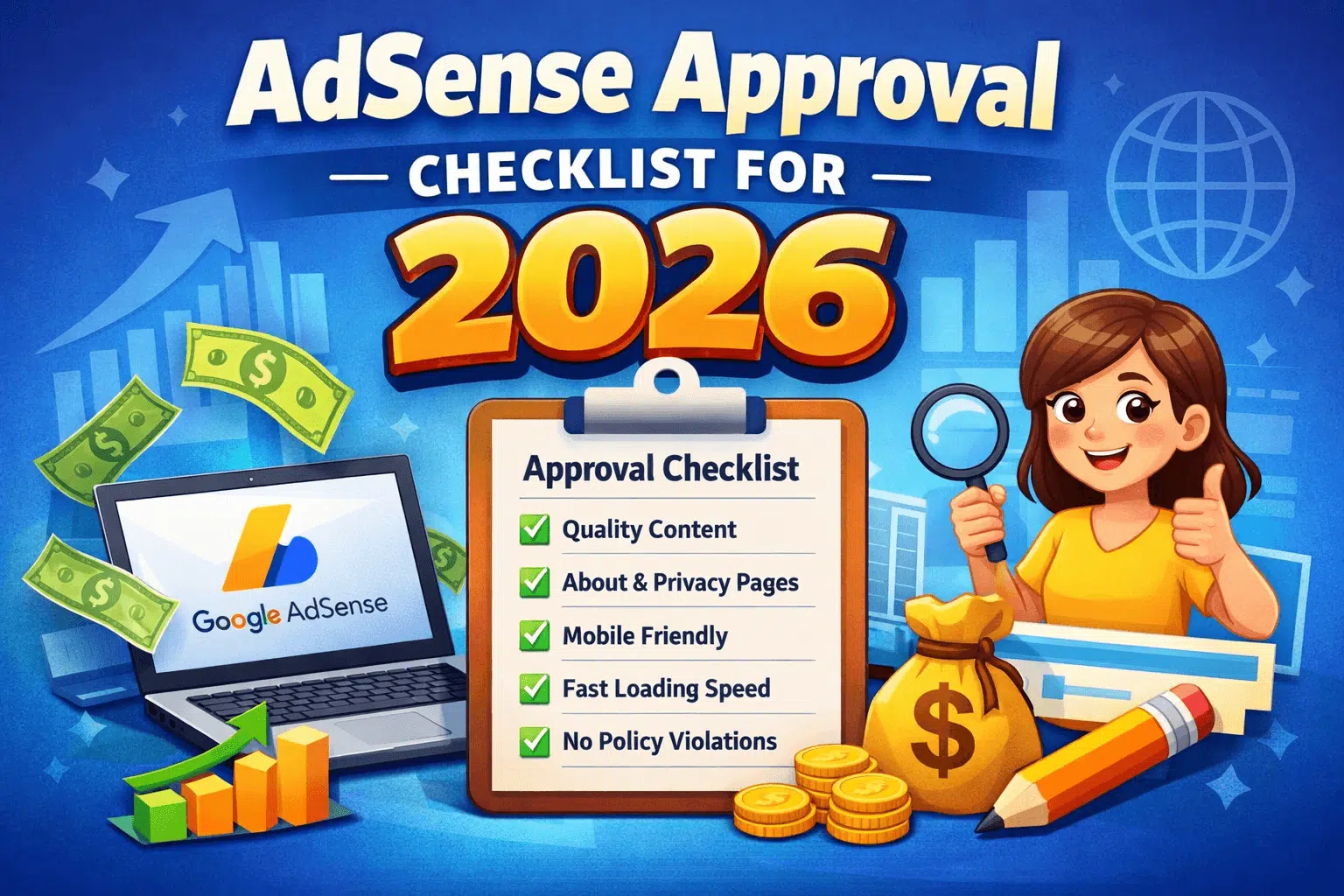

The website requirements for AdSense approval are not a secret formula based on a fixed number of posts, a premium theme, or guaranteed traffic. Google’s current eligibility guidance focuses on whether you have your own high-quality content, comply with its policies, control the submitted website, and meet the account age requirement. Your site must also be accessible and provide a usable experience.
This guide explains what your website should have before you apply. It covers ownership, content, structure, trust pages, policy compliance, mobile usability, technical access, traffic quality, and WordPress preparation. When the site meets these requirements, use the AdSense site review checklist for the final pre-submission audit.
For the complete learning path—including application, rejection fixes, and growth—return to the Google AdSense guide hub.
Quick Answer: What Does a Website Need for AdSense?
Before applying, your website should contain original and useful content, have a clear purpose, work through simple navigation, and be publicly accessible. You should control the domain and be able to add the required verification method. The site must comply with Google Publisher Policies, use legitimate traffic sources, work on mobile devices, and explain relevant privacy and publisher information accurately.
| Requirement | What it means | Strong readiness signal |
|---|---|---|
| Eligible account holder | The applicant meets Google’s account requirements | Real and consistent account information; applicant is 18 or older |
| Site ownership | You control the submitted website | You can edit the site and complete an accepted verification method |
| Original content | Pages provide unique, useful value | No copied, scraped, spun, or mass-produced low-value sections |
| Clear site purpose | The audience and subject are understandable | Homepage, categories, About page, and posts support one coherent direction |
| Navigation | Visitors can find and use the content | Menus, links, categories, forms, and key templates work |
| Transparency | Publisher and data practices are explained | Accurate About, Contact, Privacy Policy, and relevant disclosures |
| Policy compliance | The complete site follows applicable Google policies | No known content, copyright, traffic, or deceptive-behaviour issue |
| Technical access | Google can reach and inspect the site | Live HTTPS pages, valid certificate, correct URL, no crawler or login block |
| User experience | Content is usable on common devices | Readable mobile layout without obstructive pop-ups or misleading controls |
1. Meet the Basic AdSense Eligibility Requirements
Use your own content
Google’s eligibility guidance asks whether you have your own unique and interesting content. Your pages should be created for a real audience and offer enough value to attract and retain readers. Passing a plagiarism checker alone does not establish quality. A page can use different wording and still add almost nothing beyond existing results.
Control the submitted website
You need to control the site you submit. For a normal self-hosted website, this means being able to change the HTML or use a supported connection method. Confirm that you can edit the site header, publish a verification meta tag, manage ads.txt, or use the integration shown in your AdSense account.
Follow the policies
Your content and implementation must comply with the AdSense Program policies and Google Publisher Policies. Policy responsibility continues after approval, so do not treat compliance as a one-time application task. Review current official documentation whenever you publish sensitive content or change your monetisation setup.
Meet the age requirement
An AdSense applicant must be at least 18 years old. If the website owner is younger, Google explains that a parent or guardian may sign up using the adult’s own Google Account; payments are then made to the responsible adult.
2. Publish Original, Useful, and Complete Content
Create value beyond a rewritten summary
Strong content answers the reader’s main question and contributes something useful. Depending on the topic, that can include original instructions, local context, verified comparisons, examples, calculations, templates, screenshots, testing, or first-hand experience. Cite authoritative sources for facts that can change and distinguish your own conclusions from confirmed information.
AI can assist research or drafting, but it does not remove the publisher’s responsibility. Fact-check every claim, remove generic repetition, correct invented information, and add meaningful human review. Publishing large numbers of similar pages designed mainly to capture search traffic can weaken the entire site.
Finish every publicly visible section
Remove lorem ipsum, default theme content, sample products, broken shortcodes, blank author profiles, unfinished tables, test forms, and “coming soon” sections. Review category, tag, search, author, attachment, pagination, and 404 templates—not only posts and pages.
Use the length the topic needs
Google does not publish a universal minimum word count for AdSense approval. A short page can be complete for a narrow question, while a tutorial may require steps, examples, warnings, and screenshots. Avoid padding content to reach an invented target. Completeness, usefulness, clarity, and originality matter more than an arbitrary number.
Avoid duplicate search intent
Do not publish several articles that answer the same query with slightly different titles. Choose one primary URL for each intent, merge the strongest useful information, and redirect a replaced URL when appropriate. For example, this page owns the “website requirements” intent, while the site review checklist owns the final audit intent.
3. Build Enough Content for a Complete Publication
There is no universal requirement for exactly 10, 20, 30, or 50 posts. However, a website with two brief articles, several empty categories, and an unfinished homepage may not demonstrate enough unique value or a good user experience.
Use these questions instead of chasing a fixed post count:
- Does each important category contain useful, related articles?
- Can the homepage clearly introduce the site and guide readers to its best resources?
- Do the main articles answer the audience’s essential questions?
- Can visitors continue through helpful internal links?
- Are old, thin, duplicate, or inaccurate pages updated or consolidated?
A focused site with fewer high-value pages is generally more convincing than a large collection of weak or unrelated content. Publish because the topic deserves a page, not merely to increase the post counter.
- Main menu: Include the homepage and the site’s most important sections without overcrowding it.
- Categories: Use descriptive categories that contain closely related posts. Avoid creating a category for every article.
- Internal links: Connect hubs, pillars, and supporting articles using anchors that explain the destination.
- Footer: Make important trust and policy pages easy to find.
- Functional elements: Test search, pagination, breadcrumbs, dropdowns, contact forms, buttons, and downloads.
- Broken URLs: Fix dead internal links and use relevant redirects only when one page genuinely replaces another.
A visitor should understand where they are, what the page covers, and where to go next. Avoid misleading buttons, fake download links, unexpected redirects, or layouts that make ordinary content look like an advertisement.
5. Publish Accurate Trust and Privacy Pages
Trust pages do not guarantee approval, but they help readers understand who is responsible for the website and how it operates. Build them as genuine resources rather than copied approval decorations.
About page
Explain who publishes the website, whom it serves, what subjects it covers, and how content is produced or reviewed. Avoid invented credentials, fake team members, or stock photos presented as real staff.
Contact page
Provide a monitored email address or working contact form so readers can report errors and ask legitimate questions. Test delivery from a logged-out browser instead of assuming the form works.
Privacy Policy
Describe the website’s actual use of cookies, advertising, analytics, contact forms, comments, embedded media, security services, newsletters, and third-party integrations. Privacy and consent duties depend on your implementation and visitors’ locations. A generic template is not legal advice and should not name tools you do not use or omit tools you do use.
Terms and disclosures
Add terms, affiliate disclosures, sponsored-content disclosures, editorial policies, or subject-specific disclaimers when relevant. Place disclosures where readers can reasonably notice them. The important pages for AdSense approval guide explains this area in more detail.
6. Make the Entire Site Policy-Compliant
Review all content that users and crawlers can reach: posts, pages, images, embedded videos, comments, downloads, profile pages, outbound links, and category archives. Your responsibility is not limited to the article where an ad may eventually appear.
- Remove prohibited content and handle restricted topics according to current Google rules.
- Do not distribute pirated software, movies, books, templates, or copyrighted images without permission.
- Remove malware, unwanted redirects, deceptive claims, and buttons that imitate navigation or downloads.
- Moderate spam comments, unsafe user uploads, and suspicious outbound links.
- Do not place ads or future ad locations where they could be confused with menus, download buttons, or site controls.
- Do not encourage visitors to click ads or promise compensation for views or clicks.
Review the AdSense policies for publishers before applying, then continue monitoring policy updates after approval.
7. Use Legitimate Traffic Sources
Google does not publish a universal daily-pageview requirement for a standard AdSense website application. A lack of an official traffic minimum does not make artificial traffic safe. Do not buy bots, participate in paid-to-click or click-exchange programmes, send spam, auto-refresh pages, or ask friends and family to click future ads.
Understand where your users come from. Organic search, direct visits, genuine referrals, newsletters with permission, and honest social promotion can all be legitimate. Investigate unexplained spikes, extremely short automated-looking sessions, and referrals from unknown networks. Read the AdSense invalid traffic guide before monetisation.
8. Meet Technical Access and Security Requirements
- Submit the exact production domain, with correct spelling and the preferred www or non-www version.
- Keep the website published and accessible without an administrator login or password barrier.
- Use a valid SSL certificate for HTTPS and fix redirect loops or mixed-content warnings.
- Check robots.txt, firewall, CDN, and security-plugin rules so the AdSense crawler is not accidentally blocked.
- Resolve recurring DNS, server, database, or 5xx errors.
- Ensure important public pages are not accidentally marked noindex.
- Keep a current backup before changing themes, plugins, caching, redirects, or header code.
Google’s current troubleshooting guidance lists missing or incomplete code, an unreachable site, insufficient unique content or poor user experience, and policy violations among common “not ready” causes. Technical access therefore matters as much as editorial preparation.
9. Provide a Good Mobile User Experience
- Text should be readable without zooming.
- The mobile menu and dropdowns should open and close correctly.
- Buttons and links should be easy to tap without accidental clicks.
- Tables, images, videos, and code blocks should fit the screen or scroll safely.
- Cookie banners and pop-ups should not hide the main content or trap the visitor.
- The page should remain stable while fonts, images, widgets, and advertisements load.
You do not need a perfect laboratory performance score, but slow and unstable pages can damage usability. Compress oversized images, remove unused scripts, use caching carefully, and test several important pages on a real phone and a slower connection.
10. WordPress Requirements Before Applying
- In Settings → Reading, confirm that “Discourage search engines from indexing this site” is disabled on the live website.
- Use only one SEO plugin to control titles, canonical URLs, sitemaps, and index settings.
- Update WordPress core, the active theme, and necessary plugins after taking a backup.
- Remove unused plugins and themes that create security or performance risks.
- Check category, tag, author, attachment, search, and 404 templates for low-value output.
- Use one reliable AdSense connection method rather than injecting duplicate code through several plugins and theme settings.
- Clear relevant caches after updating redirects, robots rules, meta tags, ads.txt, or verification code.
When you are ready to connect the site, follow the WordPress AdSense connection guide.
Common AdSense Requirement Myths
| Claim | Better guidance |
|---|---|
| Every website needs exactly 20 or 30 posts | No universal post count guarantees approval; build enough quality content for a complete site. |
| Every post must contain 1,500 words | Use the length needed to answer the topic without padding. |
| A site needs a fixed amount of daily traffic | No universal standard-site pageview threshold is published; traffic must be legitimate. |
| A premium theme guarantees approval | A simple free theme can work when it is usable, secure, accessible, and complete. |
| A domain must always be six months old | Do not apply a blanket rule to every country or product; follow the eligibility information shown for your situation. |
| About and Contact pages guarantee approval | They improve transparency, but they cannot compensate for weak content or policy problems. |
| A plagiarism score proves content quality | Original wording does not automatically mean the page is useful, accurate, or valuable. |
Website Requirements Checklist
- ☐ The applicant is eligible and uses accurate account information.
- ☐ You control the correct production domain.
- ☐ The website is live and publicly accessible.
- ☐ The site has a clear subject, audience, and purpose.
- ☐ Important content is original, useful, accurate, and complete.
- ☐ Copied, thin, outdated, and overlapping pages are fixed.
- ☐ Demo content and unfinished public sections are removed.
- ☐ Menus, categories, internal links, forms, and templates work.
- ☐ About, Contact, Privacy Policy, and relevant disclosures are accurate.
- ☐ Content, media, downloads, comments, and links pass a policy audit.
- ☐ Images and other assets are owned, licensed, or properly attributed.
- ☐ Traffic sources are legitimate and explainable.
- ☐ HTTPS, redirects, robots rules, and server access work.
- ☐ The site is readable and usable on mobile devices.
- ☐ You can complete the connection method shown by AdSense.
After meeting these requirements, run the more detailed 35-point AdSense site review checklist. Then use the step-by-step AdSense application guide.
Frequently Asked Questions
How many posts are required for AdSense approval?
Google does not publish one universal post-count guarantee for every standard website. Your site needs enough original, useful content to demonstrate a clear purpose and good visitor experience.
How old should a website be before applying?
Do not rely on a blanket domain-age number for every applicant. Follow the current eligibility information applicable to your location and product. Regardless of age, the website should be complete and policy-compliant before submission.
Is traffic required before applying?
Google does not state one universal daily-pageview threshold for standard website approval. Genuine audience signals can help demonstrate usefulness, but artificial visits and incentivized activity create serious risk.
Is a Privacy Policy necessary?
A website using advertising, cookies, analytics, forms, or other personal-data tools should provide accurate privacy disclosures and meet applicable consent duties. The policy must reflect the site’s real implementation.
Can a free WordPress theme get AdSense approval?
Yes. The theme’s price is not a quality requirement. A free theme can provide an excellent experience when it is secure, responsive, readable, stable, and properly configured.
Does meeting every requirement guarantee approval?
No. Google makes the final decision, and no independent checklist can guarantee it. Meeting the requirements helps remove avoidable problems and makes the site more useful regardless of the review outcome.
Final Verdict
A website is ready to move toward AdSense when it is owned and controlled by an eligible applicant, offers original value, works as a complete publication, follows policies, explains its data practices, uses legitimate traffic, and remains accessible on desktop and mobile. Do not build toward a mythical post or traffic number. Build a website that deserves repeat visitors.
Once these foundations are in place, complete the final site review and follow the current instructions inside your AdSense account.
Official references: AdSense eligibility requirements, AdSense Program policies, and what to do when a site is not ready.
Last reviewed: September 10, 2026. Google policies and product interfaces can change. Confirm the current requirements in official documentation and your AdSense account before applying.