
Remote data entry jobs in the USA include record updating, order entry, document indexing, data verification and similar administrative work completed from home. Some vacancies accept applicants without prior data-entry experience, but “remote,” “entry level” and “no experience” are not guaranteed for every listing. Employers may require U.S. work authorization, residence in an approved state, fixed working hours, a skills test or industry knowledge.
This guide gives you 20 legitimate job-title ideas to search, explains how to verify pay and current openings, and shows how to avoid common scams. It does not claim that every role or employer listed is hiring today.
Quick answer: search official employer career pages and established job boards using several related titles—not only “data entry.” Read each posting for location, employment type and pay. Never pay a fee to get a job or deposit a check and send part of the money elsewhere.
Remote Data Entry Jobs USA: What to Expect
Data entry is not one standardized job. The work may appear inside administrative, records, billing, operations, e-commerce or customer-support teams. Typical duties include entering information, checking records against source documents, correcting errors, labeling files and updating spreadsheets or internal systems.
Many listings are location-restricted even when the work is remote. A company may hire only in selected U.S. states because of payroll, tax, licensing, client or time-zone requirements. “Remote in the USA” therefore does not mean “work from any country.” Read the location and work-authorization section before applying.
Can you get hired with no experience?
It is possible, but the employer still needs evidence that you can do accurate work. A beginner can demonstrate spreadsheet basics, typing accuracy, proofreading, file organization and careful handling of confidential information. Medical, legal, payroll and accounting-related roles may require training or prior knowledge even when the work includes data entry.
If you are comparing a wider range of opportunities, see these remote jobs that may not require a degree. “No degree” is different from “no skills” or “no experience,” so always follow the individual job description.
20 Remote Data Entry Job Titles to Search in 2026
The titles below are search terms, not a list of guaranteed vacancies. Availability changes daily, and some employers use different names for similar work. Try a title together with keywords such as remote, entry level, United States, your state and the relevant industry.
General Entry and Records Roles
| Job Title | Typical Work | Beginner Note |
|---|---|---|
| 1. Data Entry Clerk | Enter and update records in spreadsheets or business systems. | Some roles accept related administrative or school-project experience. |
| 2. Data Entry Keyer | Transfer information from source documents into a database. | Accuracy and a timed typing test may matter more than speed alone. |
| 3. Records Clerk | Organize, update and retrieve digital records. | May require knowledge of retention and confidentiality rules. |
| 4. Document Indexing Clerk | Label scanned documents and connect them to the correct record. | Useful search term for insurance, legal and healthcare operations. |
| 5. Data Verification Clerk | Compare entries with source documents and flag discrepancies. | Good fit for applicants who can show careful proofreading. |
Orders, Inventory and E-Commerce Roles
| Job Title | Typical Work | Beginner Note |
|---|---|---|
| 6. Order Entry Specialist | Enter orders, verify customer details and update order status. | Customer-service or retail experience may transfer. |
| 7. Inventory Data Clerk | Update stock counts, product codes and warehouse records. | Some positions follow warehouse or retail operating hours. |
| 8. Product Listing Specialist | Add titles, descriptions, prices and attributes to online catalogs. | Basic spreadsheet and e-commerce knowledge helps. |
| 9. Catalog Data Specialist | Standardize product records and correct duplicate or missing fields. | Employers may test attention to naming and formatting rules. |
| 10. CRM Data Cleanup Assistant | Correct contact records, remove duplicates and categorize leads. | Search for CRM platforms such as Salesforce or HubSpot in listings. |
Billing, Claims and Specialized Records Roles
| Job Title | Typical Work | Beginner Note |
|---|---|---|
| 11. Billing Data Entry Clerk | Enter invoice details and update billing records. | Basic accounting terminology may be required. |
| 12. Accounts Receivable Clerk | Post payments, maintain customer balances and research discrepancies. | This is broader than basic data entry and may require accounting experience. |
| 13. Claims Data Entry Clerk | Enter or validate insurance claim information. | Industry terminology and privacy training may be required. |
| 14. Medical Records Specialist | Maintain patient records and verify documentation. | Not automatically a no-experience role; training or certification may be preferred. |
| 15. Payroll or Timekeeping Clerk | Review hours, employee data and payroll-related records. | Accuracy, deadlines and payroll-system knowledge are important. |
Research, Annotation and Administrative Roles
| Job Title | Typical Work | Beginner Note |
|---|---|---|
| 16. Survey Data Processor | Review responses, code fields and prepare survey records. | Project-based availability is common. |
| 17. Research Data Assistant | Collect information from approved sources and organize findings. | May require subject knowledge and careful source documentation. |
| 18. Data Annotation Specialist | Label text, images or other material using project guidelines. | Often project-based; it is related to data work but not traditional clerical entry. |
| 19. Transcription and Data Capture Clerk | Convert audio or scanned information into structured records. | Employers may require a transcription, grammar or accuracy test. |
| 20. Administrative Assistant with Data Entry | Combine record updates with email, scheduling and document tasks. | Broader administrative skills can create more search results than “data entry” alone. |
Important: related titles can involve different duties, qualifications and pay. Do not present all 20 as interchangeable or as open today. Use the employer’s current posting as the source of truth.
How Much Do Remote Data Entry Jobs Pay?
There is no reliable universal promise that remote data entry jobs pay $15–$25 per hour. Pay varies by occupation, state, employer, schedule, employment status and specialized knowledge. A genuine listing should explain the compensation method or provide it when required by applicable pay-transparency law.
For context, the U.S. Bureau of Labor Statistics reported a national mean hourly wage of $19.47 and a median hourly wage of $18.26 for data entry keyers in May 2023. That is an occupational benchmark—not a guarantee for a particular remote vacancy, beginner or state. Check the latest BLS Occupational Employment and Wage Statistics tables and compare them with the exact job posting.
Use this pay-checking method
- Confirm whether the role is an employee job or independent-contractor project.
- Read the posted hourly rate, salary or per-project payment terms.
- Check expected hours, unpaid training claims, equipment costs and benefits.
- Compare the duties with the correct BLS occupation and your state’s market.
- Ask for written clarification before accepting an offer with unclear compensation.
A high advertised amount deserves extra scrutiny when the duties are extremely simple, the recruiter avoids an interview or the company asks you to move money. Specialized jobs can pay more, but they may also require healthcare, accounting, legal, software or industry knowledge.
Where to Find Current Remote Data Entry Openings
Hiring status changes too quickly for an undated list of “companies hiring now.” Search current vacancies and verify each result on the employer’s own careers domain before applying. Do not assume that a company offering remote work in the past has a matching vacancy today.
Search official employer career pages
Use several terms: data entry, records, order entry, document indexing, data quality, claims, billing, operations support and administrative assistant. Then filter for remote location and the United States. Open the full posting and confirm the state, schedule, duties, qualifications and closing date.
Use job boards as discovery tools
LinkedIn, Indeed and specialist remote job boards can help you discover listings, but a board label is not final proof that the employer or recruiter is legitimate. Compare platforms in BlogerHub’s guide to the best remote job boards in the USA, then verify promising opportunities on the company website.
Set focused alerts
Create separate alerts for two or three titles that match your skills. Add your state because many remote jobs have geographic restrictions. Alerts are more useful than repeatedly searching a broad phrase, but you should still review every result manually.
Skills and Equipment Employers May Expect
| Requirement | How to Demonstrate It |
|---|---|
| Accuracy | Complete a sample spreadsheet and check it against the source. |
| Typing | Record a recent typing-test result, including accuracy—not only words per minute. |
| Spreadsheet basics | Show sorting, filtering, formatting, data validation and simple formulas. |
| Confidentiality | Explain how you protect files, passwords and private records. |
| Written communication | Use concise, error-free email and application responses. |
| Reliable setup | Check whether the employer requires specific internet speed, equipment or a private workspace. |
Never purchase equipment from an unknown “vendor” using a check sent by a recruiter. A legitimate company should explain its equipment and reimbursement process in writing.
How to Apply Without Prior Data Entry Experience
1. Build a small proof-of-skill sample
Create a spreadsheet using fictional or public data. Standardize capitalization, remove duplicates, validate required fields and add a short quality-check note. Do not use confidential information from a current or former employer.
2. Translate related experience
Retail, volunteering, school projects, customer service and office work may provide relevant evidence. Mention tasks such as maintaining records, checking orders, scheduling, processing forms or using spreadsheets. Avoid invented numbers or claims you cannot explain in an interview.
3. Match the resume to the posting
Use the employer’s accurate terminology for skills you genuinely have. Prioritize accuracy, software, record handling and results. If you want broader entry-level options, compare these work-from-home jobs in the USA.
4. Check restrictions before applying
Confirm approved states, time zone, working hours, background-check requirements, employee or contractor status and work authorization. This prevents wasted applications and helps you compare offers accurately.
5. Track applications
Keep a simple spreadsheet with the employer, official posting URL, title, date applied, compensation, location rule and status. Save the job description because listings may close before an interview.
How to Avoid Remote Data Entry Job Scams
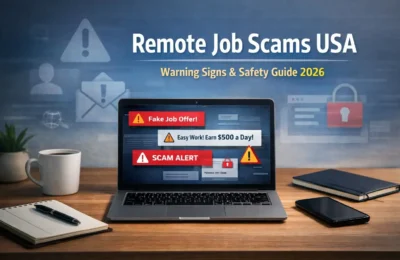
Data entry is frequently used as bait in fake-job messages because the work sounds accessible. The U.S. Federal Trade Commission warns that honest employers will not ask you to pay to get a job. The FTC also warns about fake-check schemes in which a supposed employer sends a check for equipment and asks the applicant to send money onward.
- Upfront fee: do not pay for a guaranteed job, required starter kit or access to wages.
- Fake check: do not deposit a check and buy equipment or return excess money.
- Text-only interview: be cautious when the recruiter refuses normal verification or moves immediately to an offer.
- Look-alike email: inspect the sender’s domain and compare it with the official company website.
- Early sensitive-data request: do not send banking details or identity documents before verifying the employer and hiring stage.
- Unrealistic promise: question unusually high pay for vague, simple tasks with no screening.
Read the FTC’s job-scam guidance and BlogerHub’s detailed guide to remote job scams in the USA. If you already paid a scammer or shared information, follow the FTC reporting and recovery steps promptly.
FAQ About Remote Data Entry Jobs USA
Are remote data entry jobs available with no experience?
Some entry-level postings accept applicants without prior data-entry employment, but they still usually require accuracy, computer skills and reliable communication. Specialized records, medical, payroll, claims or accounting roles may need training or experience. Treat “no experience” as a listing-specific requirement, not a promise covering the entire occupation.
Do all remote data entry jobs pay $15–$25 per hour?
No. Compensation varies by duties, location, employer, employment status and experience. Use the exact vacancy as the primary source and compare it with an appropriate BLS occupational benchmark. Per-project offers should be converted into an estimated hourly amount after including unpaid administrative time and legitimate expenses.
Which companies are hiring remote data entry workers now?
There is no permanent list because openings change frequently. Search current official career pages using related titles such as records clerk, order entry specialist and administrative assistant. A company that hired for data work previously should not be described as hiring now unless a current, location-compatible vacancy can be verified.
What typing speed is required?
There is no universal requirement. Some employers publish a target or give a timed test, while others emphasize accuracy and system knowledge. Report both your speed and accuracy only if the result is recent and repeatable. Follow the number stated in the vacancy instead of relying on a generic internet benchmark.
Can someone outside the USA apply for a U.S. remote job?
Only if the employer explicitly permits that location and the applicant meets its work-authorization or contractor requirements. “Remote USA” commonly means the worker must live and be legally able to work in the United States, sometimes in selected states. Never misrepresent your location or authorization.
Should I pay for access to a data entry job?
No legitimate employer should charge you to receive a job. A separate job board may sell a subscription, but that does not guarantee employment and should be evaluated independently. Never send money to a recruiter, buy equipment through an unknown vendor or return money from a deposited check.
Final Checklist Before You Apply
- Open the vacancy on the employer’s official careers website.
- Confirm that it is remote and that your state or country is eligible.
- Read the duties, experience, schedule and work-authorization requirements.
- Verify pay, worker classification and equipment terms in writing.
- Tailor your resume with truthful, relevant evidence.
- Stop if anyone asks for an upfront fee, gift card, cryptocurrency or check forwarding.
Remote data entry can be one route into administrative work, but it is not automatically easy, flexible, high-paying or available without screening. Search several accurate job titles, verify every vacancy and build evidence of careful spreadsheet and record-handling skills. For more options, explore BlogerHub’s remote jobs guide.