

You can qualify for some remote jobs in the United States without having a four-year college degree. However, no degree required does not mean no skills, training, or experience are required. Employers may still expect strong communication, software knowledge, relevant work samples, previous customer experience, certifications, or a high-school diploma.
This guide explores realistic remote jobs without a degree, the skills and tools employers may expect, ways to build experience, trusted places to search, and warning signs of fake work-from-home offers.
Last reviewed: July 2026. Job availability, qualifications, location restrictions, schedules, and pay vary by employer. Always read the complete job description before applying.
Remote Jobs Without a Degree: Quick Answer
Possible remote roles that may not require a bachelor’s degree include customer support, chat support, virtual assistance, data entry, product listing, sales support, online research, content moderation, social-media assistance, and WordPress content support.
Applicants still need relevant skills and evidence that they can complete the work. Start by choosing one role, studying real job descriptions, learning the required tools, creating a sample project, and applying through established job boards or official company career pages.
New to remote work? Visit our complete remote jobs guide for beginners.
What Does “No Degree Required” Really Mean?
A job marked “no degree required” generally means the employer does not require a bachelor’s degree as a standard entry qualification. The company may still ask for a high-school diploma, relevant experience, software knowledge, communication skills, a background check, or job-specific training.
Requirements can also differ within the same occupation. One employer may train a beginner, while another may require several years of related experience. Some listings may say that a degree is preferred but accept equivalent professional experience.
Read the education, experience, location, equipment, schedule, and legal-work-authorization requirements carefully. Do not assume that every no-degree role is also an entry-level job.
Remote Jobs Without a Degree at a Glance
| Remote job | Typical tasks | Useful starting skills | Possible education requirement |
|---|---|---|---|
| Customer support | Answering questions and resolving customer issues | Communication and product knowledge | High-school diploma may be required |
| Chat support | Helping customers through live chat or messaging | Typing and written communication | Varies by employer |
| Virtual assistance | Email, scheduling, research, and administrative support | Organization and digital tools | Varies by employer or client |
| Data entry | Entering, reviewing, and organizing records | Typing, accuracy, and spreadsheets | Varies by employer |
| Product listing | Uploading product information, images, and prices | Accuracy and e-commerce basics | Often skills-based |
| Sales support | Contacting leads and updating customer records | Communication and CRM basics | High-school diploma may be required |
| Online research | Finding, checking, and organizing information | Search and source verification | Varies by project |
| Content moderation | Reviewing user-generated content against guidelines | Judgment and attention to detail | Varies by employer |
| Social-media assistance | Scheduling posts and supporting community responses | Platform knowledge and writing | Often skills-based |
| WordPress content support | Uploading and formatting website content | WordPress and basic HTML | Often skills-based |
The word “remote” describes where the work is completed, not the employer’s education requirements. Always confirm the qualifications for each individual listing.
Best Remote Jobs Without a Degree
The following roles may provide possible starting points for people without a bachelor’s degree. Availability and requirements differ by employer, and none of these roles is guaranteed to be entry-level.
1. Remote Customer Support Representative
Customer support representatives help customers understand products, resolve account problems, process orders, and report technical or service issues. Support may be provided through phone calls, email, live chat, or a combination of channels.
Employers may look for:
- Clear verbal and written communication
- Patience and problem-solving ability
- Basic computer skills
- Availability during assigned shifts
- A reliable internet connection and quiet workspace
- Previous retail, hospitality, or customer-service experience
Some employers provide product and software training after hiring. Others may require previous support experience.
2. Remote Chat Support Agent
Chat support agents assist customers through written conversations instead of regular phone calls. They may answer product questions, explain account features, troubleshoot simple problems, and document each interaction.
Useful skills include fast and accurate typing, professional writing, reading comprehension, and the ability to handle several conversations carefully.
Applicants who prefer written communication can also explore our guide to remote jobs without phone calls.
3. Virtual Assistant
Virtual assistants provide administrative support to businesses, entrepreneurs, or teams. The role can include email organization, calendar management, online research, meeting preparation, document formatting, and basic customer communication.
Employers or clients may expect familiarity with:
- Google Workspace or Microsoft Office
- Email and calendar systems
- Video-meeting software
- Task-management tools
- File organization and sharing
- Professional written communication
Virtual-assistant work can range from simple administrative tasks to specialized support requiring bookkeeping, marketing, or project-management experience.
4. Remote Data Entry Clerk
Data-entry work may involve entering information into spreadsheets or business systems, reviewing records, correcting formatting, checking missing information, and comparing data against source documents.
Applicants usually need accuracy, attention to detail, spreadsheet knowledge, and the ability to follow instructions. Some jobs may also require industry knowledge or experience with a specific database.
Because fake data-entry offers are common, verify the employer carefully and never pay a registration or activation fee. Read our guide to remote data-entry jobs in the USA.
5. Product Listing Assistant
Product listing assistants upload and maintain information for online stores. Common tasks include adding product names, descriptions, images, prices, categories, stock information, and search attributes.
Useful skills include spreadsheet work, accurate writing, basic image handling, and familiarity with platforms such as Shopify, WooCommerce, Amazon Seller Central, or another e-commerce system.
A beginner can create a sample portfolio by preparing five complete product listings for an imaginary online shop.
6. Remote Sales or Sales-Support Representative
Remote sales representatives communicate with potential customers, explain products or services, update lead records, schedule demonstrations, and follow up with prospects. Sales-support workers may focus more on research, data updates, appointment scheduling, and administrative tasks.
Some roles include phone or video communication, performance targets, and commission-based compensation. Review the base pay, commission structure, employment status, and expectations before accepting an offer.
7. Online Research Assistant
Online research assistants collect and organize information about markets, companies, products, competitors, contacts, or other subjects. They may prepare spreadsheets, short summaries, and source lists.
This work requires careful searching, source evaluation, data organization, and clear documentation. Employers may prefer applicants who understand the industry being researched.
8. Remote Content Moderator
Content moderators review posts, images, comments, listings, or user reports to determine whether they follow platform rules. They may label content, document violations, and escalate serious cases.
The role requires consistency, good judgment, attention to detail, and the ability to follow written policies. Some moderation work may involve viewing upsetting or sensitive material, so applicants should read the job description carefully.
9. Social-Media Assistant
Social-media assistants may prepare captions, schedule approved posts, organize content calendars, collect basic performance data, and help respond to routine messages.
This is different from a senior social-media manager role, which may require strategy, paid advertising, analytics, team leadership, and substantial experience.
Beginners can create a sample seven-day content calendar for a fictional local business to demonstrate planning and writing skills.
10. WordPress Content Assistant
WordPress content assistants upload, format, and update website content. Tasks may include creating headings, adding images, inserting links, formatting tables, updating categories, and checking how pages appear on mobile devices.
Useful knowledge includes the WordPress block editor, basic image optimization, internal linking, accessibility, and simple HTML. A demo website or formatted article can serve as a portfolio sample.
Skill-Based Remote Careers That May Not Always Require a Degree
Some people build remote careers in writing, search-engine optimization, design, digital marketing, web development, or technical support without completing a four-year degree. However, employers may still prefer formal education, substantial experience, certifications, or a strong professional portfolio.
Do not treat these careers as guaranteed entry-level options. Review the education requirements for each employer and be prepared to demonstrate advanced skills through projects, references, or previous work.
How Much Do Remote Jobs Without a Degree Pay?
Pay depends on the occupation, employer, location, experience, employment status, schedule, and required skills. A national occupational wage is not automatically the same as the rate for a remote vacancy.
As one reference point, the U.S. Bureau of Labor Statistics reported a median hourly wage of $20.59 for customer-service representatives in May 2024. That figure includes the broader occupation and is not limited to remote positions.
Always check the pay information in the individual listing. Also confirm whether the role is an employee position or independent-contractor work and whether benefits, overtime, equipment, taxes, or commission are included.
Review the official Bureau of Labor Statistics customer-service profile for current occupational information.
Skills and Tools Needed for No-Degree Remote Jobs
A degree may be optional, but practical skills are still important. Focus first on the skills used by the job category you selected.
| Skill | Why it matters | Tools you may encounter |
|---|---|---|
| Written communication | Email and chat are common in remote teams | Gmail, Slack, Microsoft Teams |
| Spreadsheets | Useful for records, lists, and reporting | Google Sheets, Microsoft Excel |
| Document formatting | Needed for instructions, reports, and shared files | Google Docs, Microsoft Word |
| Task management | Helps organize assignments and deadlines | Trello, Asana, Notion |
| Video communication | Used for interviews, training, and team meetings | Zoom, Google Meet, Microsoft Teams |
| Time management | Remote workers may receive less direct supervision | Calendars and time-tracking tools |
| Online research | Supports data collection and fact-checking | Search engines and source databases |
| File organization | Prevents lost or outdated project files | Google Drive, OneDrive, Dropbox |
Job advertisements are useful learning resources. Review several real listings for your chosen role and write down the tools and skills that appear repeatedly.
Portfolio Ideas for Applicants Without Experience
A sample project can show employers what you can do even when you have not held the exact job before. Create samples that resemble real workplace tasks rather than unrelated practice exercises.
- Data entry: Create, format, and clean a 50-row product spreadsheet
- Virtual assistance: Prepare a sample inbox-management plan and weekly calendar
- Product listing: Create five complete e-commerce product entries
- Social-media support: Build a seven-day content calendar with captions
- Online research: Produce a structured competitor-research spreadsheet
- Customer support: Write sample responses to five common customer questions
- WordPress support: Format a demo article with headings, images, links, and a table
For each sample, include a short explanation of the task, tools used, process followed, and final result. Do not use confidential information from a previous employer or client.
Where to Find Remote Jobs Without a Degree
Search established job boards, professional networks, staffing companies, and official employer career pages. Use filters for remote work, experience level, education, location, salary, and employment type.
- LinkedIn Jobs
- Indeed
- Remote.co
- FlexJobs
- We Work Remotely
- Staffing and recruitment company websites
- Official company career pages
A listing labelled “remote” may still be restricted to a particular country, state, time zone, or legal work location. Confirm eligibility before investing time in the application.
Compare platforms through our guide to the best remote job boards and job sites.
How to Get a Remote Job Without a Degree
Step 1: Choose One Job Category
Select a role that matches your communication style, current experience, available equipment, preferred schedule, and interests. Starting with one category makes it easier to identify the right skills and applications.
Step 2: Review Real Job Descriptions
Read at least 10 legitimate listings for the same type of job. Record the tools, tasks, experience requirements, schedules, and keywords that appear repeatedly.
Step 3: Learn the Required Tools
Practice the basic tools used in your chosen role. Avoid trying to learn every remote-work platform at once. Focus on the applications most frequently requested by employers.
Step 4: Create One or Two Sample Projects
Prepare portfolio samples based on typical workplace tasks. Review them for accuracy, consistent formatting, clear instructions, and professional presentation.
Step 5: Prepare a Targeted Resume
Your resume should highlight relevant transferable experience, tools, projects, communication skills, achievements, and training. Do not claim remote-work experience you do not have.
Experience from retail, volunteering, school projects, community work, caregiving, hospitality, or personal projects may demonstrate useful skills when described honestly and clearly.
Step 6: Search Trusted Job Sources
Use established job boards and official company career pages. Check whether the employer, recruiter, contact information, and application process can be verified independently.
Step 7: Personalize Each Application
Adjust your resume summary and application message to match the role. Mention the relevant skills, tools, and sample projects that demonstrate your ability to complete the advertised tasks.
Step 8: Track Applications and Follow Up
Use a spreadsheet to record the company, position, application date, source, contact person, interview status, and follow-up date. This helps you avoid duplicate applications and identify which approach receives better responses.
Sample Remote Job Application Message
Hello [Hiring Manager’s Name],
I am applying for the [Job Title] position. My experience with [relevant skill, task, or industry] has helped me develop strong abilities in [two relevant skills].
I am comfortable using [relevant tools] and have prepared a sample project demonstrating [relevant task]. I am also available to work during [required schedule or time zone, when applicable].
I have attached my resume and would welcome the opportunity to discuss how I could support your team.
Thank you,
[Your Name]
Personalize the message for each employer. Do not send the same generic application to every position.
How to Avoid Remote Job Scams
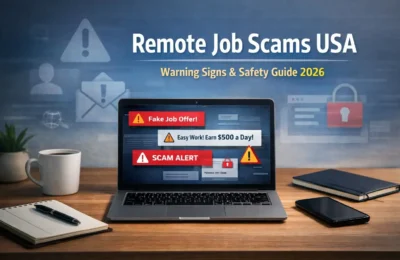
Fake work-from-home offers may promise unusually high income for very little effort, demand payment for training or equipment, send fake checks, or attempt to collect personal and banking information.
- Never pay to apply for or unlock a job
- Do not pay registration, activation, training, or security-deposit fees
- Never buy gift cards or send money after depositing an employer check
- Avoid jobs involving reshipping packages or transferring money
- Research the company and recruiter independently
- Verify the vacancy through the company’s official career page
- Be cautious of unexpected WhatsApp, Telegram, text, or social-media offers
- Do not share a PIN, OTP, password, or unnecessary identity documents
- Avoid promises of extremely high pay for simple tasks
- Do not install unknown software or open suspicious verification links
An honest employer should not ask you to pay for the promise of a job. A check appearing in your account does not necessarily mean it is legitimate or permanently cleared.
Review the official FTC work-from-home scam guidance and read our complete guide to remote job scams in the USA.
What to Expect from No-Degree Remote Work
Remote work may remove a daily commute, but it does not automatically provide flexible hours or an easy workload. Many remote employees work fixed schedules, attend meetings, follow performance targets, and remain available during specific time zones.
- Competition can be strong because applicants may come from several locations
- Some jobs are remote only within a specific state or country
- Employers may require a background check or legal work authorization
- You may need a quiet workspace and reliable internet connection
- Remote employees must manage time and communication carefully
- Entry-level roles may provide limited control over schedules
- Learning additional skills may create access to more advanced positions
Evaluate each opportunity based on the actual employer, duties, compensation, schedule, benefits, and growth path rather than the word “remote” alone.
Related Remote Job Guides
- Remote Jobs Guide for Beginners
- Best Remote Jobs for Beginners in the USA
- Best Remote Job Boards and Job Sites
- Remote Data Entry Jobs in the USA
- Remote Jobs Without Phone Calls
- Remote Job Scams and Warning Signs
FAQ About Remote Jobs Without a Degree
Can I get a remote job without a college degree?
Some remote jobs do not require a bachelor’s degree. Employers may instead evaluate relevant experience, skills, communication, software knowledge, work samples, certifications, or a high-school diploma. Requirements vary by position.
Which remote jobs may not require a degree?
Possible roles include customer support, chat support, virtual assistance, data entry, product listing, sales support, online research, content moderation, social-media assistance, and WordPress content support. Each employer sets its own requirements.
Do no-degree remote jobs require experience?
Some employers train entry-level workers, while others require previous experience. Applicants without direct experience can use transferable skills, relevant training, volunteer work, and sample projects to demonstrate ability.
How much do remote jobs without a degree pay?
Pay varies by occupation, employer, location, experience, schedule, and employment status. Review the salary or hourly rate in the individual listing and confirm whether the job includes benefits, commission, overtime, equipment, or contractor expenses.
Where can I find legitimate no-degree remote jobs?
Search established job boards, professional networks, recruitment companies, and official company career pages. Verify the employer independently and confirm that the position can hire applicants from your location.
How can I build experience without already having a remote job?
Create sample projects based on real tasks, complete relevant training, volunteer for a legitimate organization, or use transferable experience from previous work. Clearly label personal projects as samples rather than paid client work.
How can I avoid remote-job scams?
Never pay to receive a job, deposit a check and send money back, reship packages, or share account passwords and verification codes. Research the employer, verify recruiter contact details, and confirm the vacancy on the company’s official website.
Final Thoughts
A four-year degree is not required for every remote position, but employers still expect useful skills, reliable communication, and evidence that an applicant can complete the work. The most effective approach is to choose one realistic job category and prepare specifically for it.
Study real job descriptions, learn the required tools, create focused portfolio samples, prepare a targeted resume, and search through trustworthy sources. Before accepting an offer, verify the employer, schedule, location requirements, compensation, and payment process.