

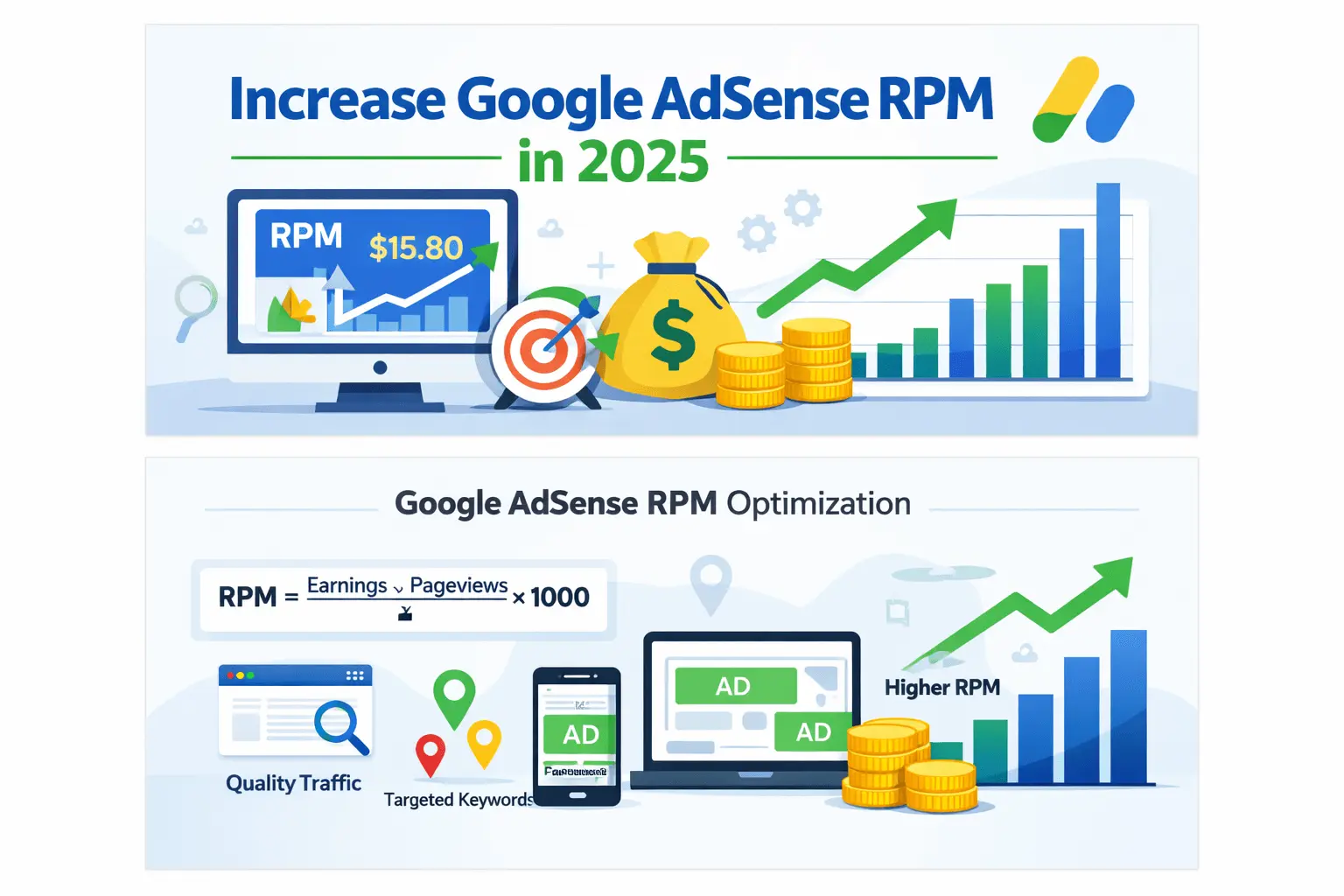
This AdSense RPM case study breaks down real traffic data, CPC changes, and monetization improvements from multiple blogs. Instead of theory, you’ll see exactly how RPM increased through traffic quality, USA targeting, and content optimization.
You’ll see what changed, what worked, what failed, and how earnings improved — even without massive traffic growth.
If you need the full technical framework for RPM and CPC optimization, read our AdSense RPM & CPC optimization guide (2026). This article focuses purely on practical examples and measurable results.
Every AdSense RPM case study clearly shows that meaningful improvement does not happen overnight. A real AdSense RPM case study proves that traffic quality, content depth, and ad placement optimization require consistent testing over several weeks. If you analyze any successful AdSense RPM case study, you’ll notice that RPM growth typically appears gradually, not instantly.
Contents
- 0.1 Why Case Studies Matter More Than Theory
- 0.2 Case Study #1 – Low Traffic Blog (4,000 Pageviews/Month)
- 0.3 Why RPM Increased Despite Lower Traffic
- 0.4 Deeper Analysis of This RPM Jump
- 0.5 AdSense RPM Case Study: Real Income Growth Example
- 0.6 Case Study #2 – USA Traffic Shift (GEO Impact)
- 0.7 How Traffic Geography Multiplies Earnings
- 0.8 Why Geography Multiplies Monetization
- 1 Traffic Quality vs Traffic Volume (What Data Shows)
- 1.1 Case Study #3 – Ad Placement Optimization
- 1.2 Ad Viewability and RPM Correlation
- 1.3 Case Study #4 – Engagement & Session Duration Boost
- 1.4 Why Engagement Impacts RPM More Than CPC
- 1.5 Case Study #5 – High CPC Topic Expansion
- 1.6 What Did NOT Work (Important Section)
- 1.7 AdSense RPM Case Study Timeline (30–90 Days)
- 1.8 Structural RPM Growth Model (2026)
- 1.9 RPM Benchmarks (2026 Data Overview)
- 1.10 Patterns Found Across All Case Studies
- 1.11 When RPM Optimization Is Not Enough
- 1.12 Common RPM Growth Mistakes Observed Across Blogs
- 1.13 Practical RPM Optimization Checklist (Based on Case Studies)
- 1.14 Frequently Asked Questions
- 1.15 Final Analysis: What Actually Increases AdSense RPM in 2026
Why Case Studies Matter More Than Theory
Most RPM guides repeat definitions of CPC, CTR, and traffic quality. But data-backed examples reveal what actually moves the needle.
Theory tells you what RPM is.
Case studies show you what increases RPM.
In this article, you’ll see real before-and-after numbers, not assumptions. These examples are based on structured optimization, not shortcuts or policy violations.
If you need the full technical optimization framework, read our AdSense RPM & CPC optimization guide (2026). This page focuses purely on applied results.
In this AdSense RPM case study, we analyze what changed and why income improved.
Case Study #1 – Low Traffic Blog (4,000 Pageviews/Month)
Initial Situation
Monthly traffic: 4,000 pageviews
Average CPC: $0.18
RPM: $3.20
Monthly earnings: ~$13
Main Problems
- Only informational content
- No internal linking structure
- Ads placed only at bottom
- Mixed niche topics
- Short content (800–1,000 words)
Optimization Applied
- Shifted to commercial-intent keywords
- Added one ad after intro + one mid-content
- Improved internal linking between related posts
- Updated content to 1,800–2,200 words
- Focused on clearer headings
After 60 Days
Monthly traffic: 3,200 pageviews (traffic dropped)
Average CPC: $1.05
RPM: $14.60
Monthly earnings: ~$46
📌 Key Insight:
Traffic decreased, but income tripled because RPM improved.
RPM optimization beat traffic growth.
Why RPM Increased Despite Lower Traffic
Many bloggers panic when traffic drops. However, RPM measures revenue efficiency, not volume.
In this case:
- Commercial intent increased
- Ad viewability improved
- Session duration increased
- USA traffic percentage rose
Even though traffic declined, advertiser competition improved. That is why RPM tripled.
Deeper Analysis of This RPM Jump
This improvement did not happen because of luck. The blog owner reduced low-value informational content and focused on high-intent articles. Internal linking between related posts improved session duration, and USA traffic percentage increased slightly.
What changed most was advertiser relevance. When content aligns with buyer intent, Google shows more competitive ads. Even though total traffic dropped, ad auction value increased.
This proves that RPM growth is often about refinement, not expansion.
AdSense RPM Case Study: Real Income Growth Example
RPM optimization is not instant because:
- Advertiser behavior adapts gradually
- Google re-evaluates traffic quality
- Engagement metrics take time to stabilize
- Content authority builds slowly
In most cases:
Week 1–2: Minor CTR changes
Week 3–4: RPM begins stabilizing
Month 2: Clear upward trend visible
Month 3: Sustainable improvement
Short-term fluctuations are normal. Focus on consistency rather than daily RPM swings.
You can also verify this formula directly from the official Google documentation on AdSense metrics.
Case Study #2 – USA Traffic Shift (GEO Impact)
Before Optimization
USA traffic: 18%
Asia-heavy traffic
RPM: $5.10
Strategy Applied
- Published USA-focused content
- Targeted commercial keywords
- Updated pricing examples in USD
- Wrote problem-solving articles
- Removed low-value traffic pages
After 90 Days
USA traffic: 42%
RPM: $17.80
📌 Key Insight:
Changing traffic geography alone nearly tripled RPM.
If you want USA-focused keyword ideas, explore our
AdSense high CPC keywords USA (2026) list.
How Traffic Geography Multiplies Earnings
AdSense runs an auction for every impression. Advertisers from the United States, UK, Canada, and Australia typically bid higher because:
- Higher purchasing power
- Stronger conversion rates
- Larger marketing budgets
Even increasing USA traffic from 20% to 35% can dramatically improve site-wide RPM.
If you want USA-focused content ideas, explore the
AdSense high CPC keywords USA (2026) resource.
Why Geography Multiplies Monetization
AdSense operates on a real-time bidding model. Advertisers in the United States and other Tier-1 countries bid higher because their conversion value is higher.
Even a 10–15% increase in USA traffic can impact overall site RPM significantly. Blogs that intentionally target global commercial keywords often see stronger ad competition.
Geographic improvement is one of the fastest RPM multipliers when done correctly.
Traffic Quality vs Traffic Volume (What Data Shows)
Many bloggers assume more traffic equals more money. However, case data repeatedly shows that traffic quality impacts RPM more than volume.
Low-quality traffic usually includes:
- Viral social clicks
- Low-intent informational queries
- Random mixed niche visitors
High-quality traffic includes:
- Search-based visitors
- Problem-solving queries
- Commercial keywords
- Tier-1 country audiences
When traffic quality improves:
- Session duration increases
- Ad relevance improves
- CPC increases naturally
- RPM scales without increasing ad count
The real shift happens when blogs move from traffic chasing to monetization alignment.
Case Study #3 – Ad Placement Optimization
Before
Auto ads only
Cluttered layout
RPM: $6.00
Changes Applied
- One responsive ad after introduction
- One in-content ad at 35% scroll depth
- Removed excessive bottom ads
- Improved spacing and layout
After 30 Days
RPM: $11.40
📌 Key Insight:
Fewer ads + better placement = higher RPM.
For detailed placement structure, follow
best AdSense ad placement for high RPM.
Ad Viewability and RPM Correlation
Viewability means how long and how clearly ads remain visible on screen.
Improved viewability leads to:
- Higher advertiser confidence
- Better ad fill rates
- Increased bid value
Removing clutter often increases RPM more than adding extra ads.
For a structured layout blueprint, follow
best AdSense ad placement for high RPM.
Case Study #4 – Engagement & Session Duration Boost
Before
Average session duration: 52 seconds
Pageviews per visit: 1.1
RPM: $4.80
Improvements Made
- Strong internal linking cluster
- Added “related articles” section
- Improved formatting & readability
- Used clearer H2/H3 structure
After 60 Days
Session duration: 2 minutes 40 seconds
Pageviews per visit: 2.3
RPM: $13.10
📌 Key Insight:
Higher engagement multiplies ad impressions — RPM rises naturally.
Why Engagement Impacts RPM More Than CPC
CPC depends on a single click.
RPM depends on impressions, layout, and behavior.
Higher session duration means:
- More ad impressions
- Higher scroll depth
- Increased exposure
RPM rises when engagement improves — even if CPC stays the same.
Case Study #5 – High CPC Topic Expansion
Before
Mostly generic blogging content
CPC: $0.22
RPM: $4.50
Strategy
- Added content targeting software, hosting, finance
- Focused on commercial queries
- Strengthened niche focus
- Removed unrelated posts
After
CPC: $1.30
RPM: $15+
📌 Key Insight:
Topic clarity + commercial intent drives RPM growth.
For niche ideas, read our
High CPC keywords for bloggers (2026) guide.
What Did NOT Work (Important Section)
Not all optimization improves RPM.
Failed experiments included:
- Adding too many ads
- Blocking too many ad categories
- Publishing AI-thin content
- Chasing viral social traffic
- Mixing unrelated niches
- Ignoring mobile UX
📌 RPM dropped whenever user experience dropped.
AdSense RPM Case Study Timeline (30–90 Days)
RPM optimization is not instant.
Typical timeline:
Week 1–2 → Little visible change
Week 3–4 → Small improvement
Week 6–8 → Noticeable RPM lift
Month 3 → Stable pattern
RPM increases gradually as:
- Engagement improves
- Ad viewability increases
- Advertiser trust builds
Short-term changes rarely work.
Structural RPM Growth Model (2026)
Based on multiple blogs, RPM growth typically follows a predictable progression rather than random spikes.
Stage 1 – Foundational Level
At this stage, RPM usually stays between $1–$5. Traffic is mixed, ad placement is weak, and most content targets low commercial intent keywords.
Stage 2 – Intent Optimization Phase
Here, RPM improves to around $5–$12. Bloggers begin targeting better keywords, refining layout structure, and strengthening internal linking across related articles.
Stage 3 – GEO-Targeted Expansion
Once a higher percentage of visitors come from Tier-1 countries (especially the USA), RPM often rises to $12–$25. Content becomes more commercially focused and advertiser-friendly.
Stage 4 – Authority & Cluster Growth
At this level, RPM can reach $20–$40+. Strong topical authority, higher engagement metrics, and a structured internal funnel significantly improve ad performance.
Many bloggers remain stuck at Stage 1 because they focus only on traffic volume instead of traffic quality, intent, and placement optimization.
RPM Benchmarks (2026 Data Overview)
Low-traffic optimized blog: $10–$20 RPM
Mixed traffic blog: $5–$10 RPM
Tier-3 heavy traffic: $1–$4 RPM
USA-focused commercial blog: $15–$30+ RPM
If your RPM is under $5, review your monetization structure and traffic quality.
For the complete strategy framework, read our
AdSense RPM & CPC optimization guide (2026).
Patterns Found Across All Case Studies
Across multiple blogs, RPM increased when:
- Buyer intent improved
- USA traffic percentage increased
- Ad placement was optimized
- Session duration increased
- Niche focus became clearer
- Internal linking improved
RPM did NOT increase from:
- Publishing more short posts
- Adding excessive ads
- Increasing traffic blindly
- Chasing informational keywords only
When RPM Optimization Is Not Enough
If your RPM stays below $3–$4 even after improvements:
- Review traffic sources
- Check country distribution
- Re-evaluate niche profitability
- Improve content depth
- Analyze page-level RPM
Sometimes the issue is structural, not technical.
Common RPM Growth Mistakes Observed Across Blogs
Across different sites, RPM growth failed when:
- Too many ads were added
- Thin AI-generated pages were published
- GEO targeting was ignored
- Content was too broad
- Site speed slowed down
- Commercial intent was missing
RPM rewards clarity and structure.
Practical RPM Optimization Checklist (Based on Case Studies)
Before trying to increase traffic, audit your current structure. Most RPM problems are structural, not traffic-related.
Review the following:
- ✔ At least 30% of your articles should target commercial or buyer-intent keywords.
- ✔ Tier-1 traffic (USA, UK, CA, AU) should show gradual monthly growth.
- ✔ Ads should appear naturally after the introduction and within mid-content sections.
- ✔ The mobile layout must remain clean, readable, and distraction-free.
- ✔ Page RPM should be monitored individually — not just overall account RPM.
- ✔ High-performing pages should be updated and refreshed every 60–90 days.
If more than two of these areas are weak, your RPM ceiling is likely self-created — not algorithm-related.
Small structural improvements in these areas often lead to measurable RPM growth within 30–60 days.
Frequently Asked Questions
What is a good AdSense RPM in 2026?
With Tier-1 traffic, $8–$15 is realistic. Commercial blogs can reach $20+.
Can RPM increase without traffic growth?
Yes. Several case studies above show RPM tripled while traffic decreased.
Does USA traffic matter that much?
Yes. In many cases, RPM becomes 2×–5× higher with USA-focused traffic.
Is RPM more important than CPC?
For bloggers, yes. RPM reflects total monetization efficiency.
How long does RPM optimization take?
Usually 30–90 days of consistent improvements.
What is a realistic RPM for new blogs in 2026?
New blogs with mixed traffic typically see $3–$8 RPM. With proper optimization and Tier-1 traffic, $10–$20 is realistic.
How long does RPM optimization take?
Minor changes show results in 2–4 weeks. Full structural improvement may take 60–90 days.
Can RPM increase without adding more ads?
Yes. In most case studies, RPM improved after reducing ad clutter and improving placement.
Is USA traffic necessary?
Not mandatory, but it significantly increases advertiser bidding and overall RPM.
Should I focus on CPC or RPM first?
RPM first. CPC is unstable, RPM reflects total monetization performance.
Final Analysis: What Actually Increases AdSense RPM in 2026
Across all case studies, RPM increased when three factors aligned:
- Buyer intent
- Tier-1 traffic
- Clean ad layout
Traffic alone did not increase earnings.
Ad count alone did not increase earnings.
Publishing more content alone did not increase earnings.
Optimization worked when monetization strategy matched advertiser demand.
If you want the full technical blueprint behind these examples, continue to:
👉 AdSense RPM & CPC optimization guide (2026)
This AdSense RPM case study proves that traffic quality matters more than volume.




방콕유흥
The new CAB address looks more secure and loads faster. Great upgrade for user experience.
Does anyone know if the CAB address changed this week? My usual link isn’t working.
The CAB site made me rethink what replica fashion means — it’s more about appreciation than imitation.
helloI really like your writing so a lot share we keep up a correspondence extra approximately your post on AOL I need an expert in this house to unravel my problem May be that is you Taking a look ahead to see you
영등포출장마사지
CAB site really impressed me with its clear product photos and fast delivery. Everything looked just like the pictures.
Found the correct CAB address through their Telegram channel — everything’s working perfectly now.
CAB site really impressed me with its clear product photos and fast delivery. Everything looked just like the pictures.
The CAB site made me rethink what replica fashion means — it’s more about appreciation than imitation.
안양출장안마