Remote job scams USA job seekers encounter are increasing as more people search for work-from-home opportunities. Remote work continues to grow rapidly across the United States, but scammers often target job seekers with fake online job listings.Thousands of companies now hire remote workers for roles in customer support, technology, marketing, writing, and administrative support.
Many job seekers searching for remote opportunities on different platforms may encounter fraudulent listings. Using trusted platforms can reduce the risk of scams.
However, the rapid growth of remote work has also created opportunities for scammers. Every year, thousands of job seekers fall victim to remote job scams in the USA.
Fraudulent employers post fake job listings that promise high salaries, flexible work schedules, or easy online income. These scams often target people searching for work-from-home jobs or entry-level remote opportunities.
Understanding how these scams work can help you protect your time, personal information, and finances.
In this guide, we will explain the most common remote job scams USA job seekers should avoid, how to identify suspicious job offers, and how to find legitimate remote opportunities safely.
Contents
- 1 Why Remote Job Scams Are Increasing
- 2 Most Common Remote Job Scams in the USA
- 3 Fake Data Entry Jobs
- 4 Fake Check Payment Scam
- 5 Equipment Purchase Scam
- 6 Reshipping Scams
- 7 Pyramid Scheme Jobs
- 8 Social Media Job Offer Scams
- 9 Warning Signs of Remote Job Scams USA Job Seekers Should Know
- 10 Requests for Upfront Payment
- 11 Unrealistic Salary Promises
- 12 Poor Communication
- 13 No Company Information
- 14 How to Verify a Remote Job Opportunity
- 15 Research the Company
- 16 Check Job Board Reputation
- 17 Look for Professional Hiring Process
- 18 Avoid Sharing Sensitive Information
- 19 How to Find Legitimate Remote Jobs
- 20 Use Verified Remote Job Boards
- 21 Apply Through Company Websites
- 22 Use Professional Networking Platforms
- 23 Report Remote Job Scams
- 24 Tips for Staying Safe While Job Hunting
- 25 Real Examples of Remote Job Scams in the USA
- 26 Platforms Where Remote Job Scams Often Appear
- 27 How Remote Job Boards Help Avoid Scams
- 28 What to Do If You Become a Victim of a Remote Job Scam
- 29 How to Protect Yourself From Remote Job Scams
- 30 Safe Platforms to Find Legitimate Remote Jobs
- 31 How to Report Remote Job Scams in the USA
- 32 Frequently Asked Questions
- 33 Final Thoughts
Why Remote Job Scams Are Increasing
Remote jobs are highly attractive to job seekers because they offer flexibility and eliminate commuting. As more people search for online work opportunities, scammers take advantage of this demand.
Fake job listings are often posted on:
- social media platforms
- fake job websites
- email job offers
- messaging apps
Scammers use these platforms to reach large numbers of job seekers quickly.
Many fraudulent listings promise:
- extremely high salaries
- minimal work requirements
- immediate hiring
If an offer seems too good to be true, it usually is.
Many beginners searching for entry-level remote opportunities are often targeted by scammers promising easy online income.
Most Common Remote Job Scams in the USA
Understanding the most common types of scams can help you avoid falling into these traps.
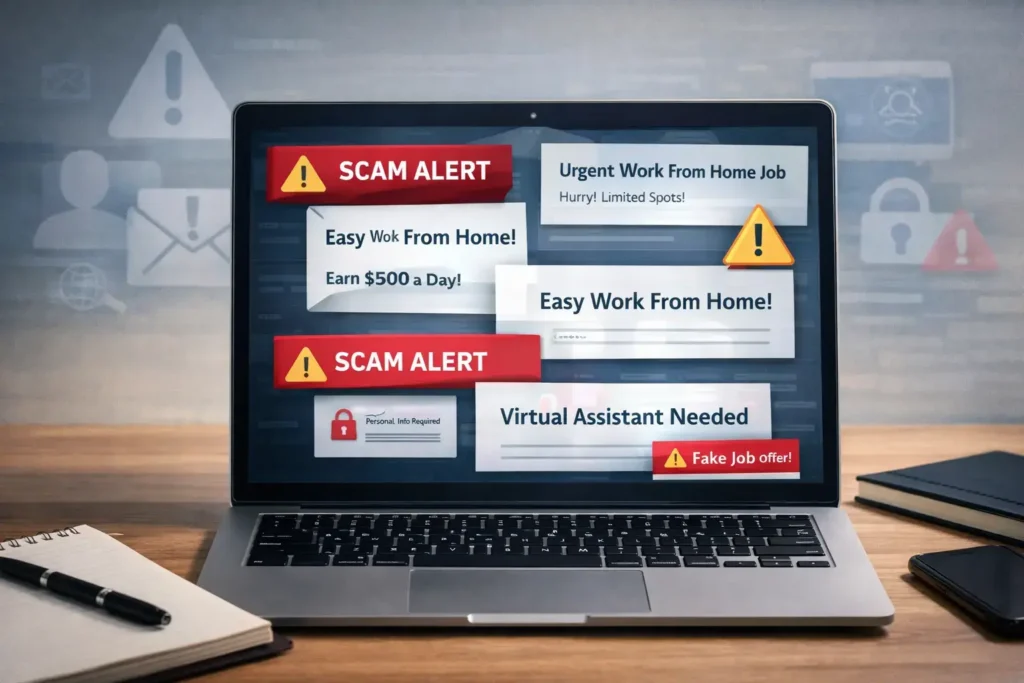
Some scammers advertise fake online jobs such as data entry roles to attract beginners.
Fake Data Entry Jobs
Data entry jobs are one of the most commonly targeted areas for scams.
Fraudulent listings promise:
- easy work from home
- high pay for simple typing tasks
- no experience required
In many cases, scammers ask applicants to pay for training materials or software before starting work.
After receiving payment, the scammers disappear.
Legitimate companies rarely require upfront payments for remote jobs.
👉 Related: Remote Data Entry Jobs USA
Fake Check Payment Scam
In this scam, a fake employer sends a check to the job seeker.
The applicant is instructed to:
- deposit the check
- purchase equipment or software
- send the remaining funds back
However, the check later turns out to be fraudulent. The victim becomes responsible for the bank loss.
This scam is frequently used in remote customer support and administrative job listings.
Equipment Purchase Scam
Some fake employers claim they will provide equipment such as laptops or software for remote work.
However, they ask the job seeker to:
- purchase the equipment first
- pay a deposit
- buy software licenses
After the payment is sent, the employer disappears.
Legitimate employers usually provide equipment directly or reimburse expenses through official channels.
Reshipping Scams
Reshipping scams involve receiving packages at home and forwarding them to another address.
Scammers claim the job involves:
- package inspection
- product testing
- shipping coordination
In reality, the packages are often purchased with stolen credit cards. The worker unknowingly becomes involved in illegal activity.
Pyramid Scheme Jobs
Some remote job opportunities are actually disguised pyramid schemes.
These scams focus on recruiting new members instead of offering real employment.
Common signs include:
- high earnings promises
- mandatory membership fees
- pressure to recruit others
Legitimate jobs pay employees for work, not for recruiting additional members.
Social Media Job Offer Scams
Many scammers use platforms such as Facebook, Telegram, and WhatsApp to promote fake job opportunities.
Typical messages include:
- “Earn $500 per week working from home.”
- “No experience needed.”
- “Start earning today.”
These offers usually lead to requests for payment or personal information.
Legitimate companies rarely recruit employees through random direct messages.
Warning Signs of Remote Job Scams USA Job Seekers Should Know
Knowing the red flags can help you avoid suspicious job listings.
Requests for Upfront Payment
One of the biggest warning signs is a request for payment before starting work.
Examples include:
- training fees
- software purchases
- background check fees
Legitimate employers typically cover these costs.
Unrealistic Salary Promises
Scam job listings often advertise extremely high salaries for simple tasks.
Examples include:
- $100 per hour data entry
- $5,000 per week working from home
- guaranteed income with minimal effort
Real jobs usually provide reasonable pay based on experience and skills.
Poor Communication
Scammers often communicate through:
- personal email accounts
- messaging apps
- informal chat platforms
Professional employers usually communicate through official company domains.
No Company Information
If a job listing does not provide:
- company website
- business address
- verifiable contact information
it may be a scam.
Always research companies before applying.
How to Verify a Remote Job Opportunity
Before applying for any remote job, take a few minutes to verify the employer.
Research the Company
Search for the company name online and review:
- official website
- employee reviews
- LinkedIn company page
Legitimate companies typically have an online presence.
Check Job Board Reputation
Using trusted job platforms significantly reduces the risk of scams.
Some reliable platforms include:
- FlexJobs
- We Work Remotely
- LinkedIn Jobs
- Indeed
👉 Related: Best Remote Job Boards USA
Look for Professional Hiring Process
Legitimate companies usually follow structured hiring processes such as:
- formal applications
- scheduled interviews
- official job contracts
Instant job offers without interviews are often suspicious.
Avoid Sharing Sensitive Information
Never share sensitive information such as:
- bank account numbers
- social security numbers
- identity documents
until you verify the employer.
How to Find Legitimate Remote Jobs
Instead of searching randomly online, use trusted platforms and strategies.
Instead of applying to unknown recruiters, consider applying directly to companies that openly hire remote employees.
Use Verified Remote Job Boards
Dedicated remote job websites screen employers before allowing job postings.
These platforms include:
- remote job boards
- curated job marketplaces
- verified company listings
Using these platforms helps reduce exposure to scams.
👉 Related: Best Remote Job Boards USA (2026 Guide)
Apply Through Company Websites
Whenever possible, apply directly through official company websites.
This reduces the chances of interacting with fake recruiters.
Use Professional Networking Platforms
Platforms like LinkedIn allow you to:
- research companies
- verify recruiters
- view employee profiles
Networking can help identify legitimate job opportunities.
Report Remote Job Scams
If you encounter a suspicious job listing, report it to the appropriate authorities.
In the United States, job scams can be reported to:
Reporting scams helps protect other job seekers from fraud.
Tips for Staying Safe While Job Hunting
Job seekers can protect themselves by following a few simple safety practices.
Use Trusted Job Platforms
Avoid applying for jobs on unknown websites or suspicious forums.
Research Employers
Always check whether a company has:
- a professional website
- verified social media accounts
- employee reviews
Trust Your Instincts
If a job opportunity seems suspicious or too good to be true, it probably is.
Real Examples of Remote Job Scams in the USA
Remote job scams often follow predictable patterns. Understanding real-world examples can help job seekers recognize suspicious offers more easily.
Fake Virtual Assistant Jobs
Some scammers advertise virtual assistant positions that promise flexible work and high pay. After the applicant applies, the “employer” requests payment for training materials or software access.
Once the payment is sent, the scammer disappears.
Fake Customer Support Jobs
In this scam, job seekers are offered remote customer service roles with well-known companies. The scammers may even conduct fake interviews through messaging apps.
Eventually, the applicant is asked to purchase equipment or software using their own money.
Legitimate companies rarely require employees to pay for equipment.
Freelance Payment Scams
Freelancers sometimes receive project offers that appear legitimate. After completing the work, the client disappears without making payment.
Using trusted freelance platforms can help reduce this risk.
Platforms Where Remote Job Scams Often Appear
While many online platforms host legitimate job listings, scammers also use these channels to target job seekers.
Social Media Groups
Some Facebook or Telegram groups advertise work-from-home jobs. These posts often promise high income with little effort.
Always verify the company before responding to such offers.
Messaging Apps
Scammers frequently use messaging apps like WhatsApp or Telegram to communicate with applicants.
Professional employers typically use official email domains and structured hiring processes.
Fake Job Websites
Some scam websites are designed to look like real job boards. They may request registration fees or personal data from applicants.
Always verify whether the platform is reputable before applying for jobs.
How Remote Job Boards Help Avoid Scams
Using trusted remote job boards can significantly reduce the risk of encountering job scams.
Reputable job boards verify employers before allowing them to post job listings. This screening process helps remove many fraudulent job offers.
Some trusted remote job platforms include curated job boards and professional networking websites.
These platforms provide verified job listings and transparent hiring processes.
👉 Related: Best Remote Job Boards USA
What to Do If You Become a Victim of a Remote Job Scam
If you suspect that you have encountered a job scam, it is important to act quickly.
Stop Communication
Immediately stop communicating with the suspected scammer.
Report the Scam
You can report job scams to organizations such as:
- Federal Trade Commission (FTC)
- Internet Crime Complaint Center (IC3)
- Better Business Bureau (BBB)
Reporting scams helps authorities investigate fraudulent activities.
Protect Your Personal Information
If you shared personal or financial information, contact your bank or financial institution immediately to prevent further damage.
How to Protect Yourself From Remote Job Scams
Remote job scams USA job seekers encounter often follow similar patterns. Learning how to protect yourself can significantly reduce the risk of falling victim to fraudulent job offers.
Verify the Company Website
Always check whether the company has a legitimate website. A real company usually provides detailed information about its services, team, and contact details.
Search for the company name along with words like “reviews” or “scam” to see if other job seekers have reported suspicious activity.
Check the Recruiter’s Email Domain
Legitimate companies usually communicate through professional email domains such as:
name@company.com
Scammers often use free email providers such as Gmail, Yahoo, or Outlook. While not every Gmail message is suspicious, you should verify the recruiter’s identity before sharing personal information.
Review the Job Description Carefully
Fake job listings often contain vague descriptions, unrealistic salary promises, or poor grammar.
Legitimate job postings typically include:
- clear job responsibilities
- required skills and experience
- company information
- structured hiring process
Search for the Job Listing Online
If a job listing appears suspicious, search the exact job title online. Many scam listings are copied and posted on multiple fake websites.
Comparing listings can help determine whether the opportunity is legitimate.
Use Trusted Job Platforms
Applying through reputable job platforms can significantly reduce scam risks.
Platforms such as LinkedIn Jobs, Indeed, and curated remote job boards verify employers before allowing job postings.
👉 Related: Best Remote Job Boards USA
How do remote job scams usually start?
Remote job scams often begin with fake job listings on social media, job websites, or unsolicited messages. Scammers may contact job seekers directly and promise high-paying work-from-home opportunities.
What should I never share with a remote employer?
You should never share sensitive information such as bank account details, social security numbers, or identity documents until you confirm the employer is legitimate.
Are remote job offers on social media safe?
Some legitimate companies advertise jobs on social media, but many scammers also use these platforms. Always verify the company before applying or responding to job offers.
Safe Platforms to Find Legitimate Remote Jobs
One of the best ways to avoid remote job scams USA job seekers often encounter is by using trusted job platforms. Reputable job boards verify employers and remove suspicious listings.
Some reliable platforms include:
- LinkedIn Jobs
- Indeed
- FlexJobs
- We Work Remotely
- Remote.co
These platforms allow job seekers to review company profiles, read employee feedback, and verify recruiter identities.
Using trusted job boards significantly reduces the chances of encountering fraudulent work-from-home opportunities. Job seekers should always apply through verified platforms rather than responding to random job offers on social media or messaging apps.
👉 Related: Best Remote Job Boards USA
How to Report Remote Job Scams in the USA
Remote job scams continue to increase as more people search for work-from-home opportunities. If you encounter a suspicious job offer, reporting the scam can help protect other job seekers from becoming victims.
In the United States, several organizations collect reports about employment fraud and online scams. These reports help authorities investigate fraudulent networks and shut down fake job listings.
Federal Trade Commission (FTC)
The Federal Trade Commission (FTC) tracks job scams and online fraud across the country. If you encounter a suspicious remote job listing, you can submit a report through the FTC website.
When filing a report, include details such as:
- the company name
- the recruiter’s email address
- screenshots of messages or job listings
- any payment requests
Providing detailed information helps investigators identify patterns used by scammers.
Internet Crime Complaint Center (IC3)
Another important reporting platform is the Internet Crime Complaint Center (IC3). This organization works with law enforcement agencies to track cybercrime, including employment scams.
If a scam involves financial transactions, identity theft, or fraudulent payments, reporting the incident to IC3 can help authorities investigate the case.
Better Business Bureau (BBB)
The Better Business Bureau also collects complaints about businesses and employment scams. Before applying for a remote job, you can search the BBB database to see if other users have reported suspicious activity related to a company.
Checking reviews and complaints can reveal whether an employer has a history of fraudulent behavior.
Why Reporting Job Scams Matters
Many job seekers assume reporting scams will not make a difference, but these reports play an important role in protecting others.
When multiple complaints are filed against the same company or recruiter, authorities can investigate the case more effectively.
Reporting scams also helps job boards remove fraudulent listings faster. This reduces the number of fake job postings that appear in search results.
Stay Alert While Job Hunting
Remote job opportunities are expanding rapidly, and many legitimate companies now hire remote workers across the United States. However, staying cautious is essential when searching for work online.
Always verify the company, review the job description carefully, and avoid offers that request payment or sensitive personal information.
By remaining informed and reporting suspicious activity, job seekers can help make remote work opportunities safer for everyone.
Frequently Asked Questions
Are remote job scams common in the USA?
Yes. As remote work becomes more popular, scammers continue to target job seekers with fake work-from-home opportunities.
How can I identify a remote job scam?
Common warning signs include requests for upfront payment, unrealistic salaries, poor communication, and lack of company information.
Are data entry remote jobs legitimate?
Some legitimate data entry jobs exist, but many listings are scams. Always research the company before applying.
Where can I find legitimate remote jobs?
Trusted platforms such as LinkedIn Jobs, FlexJobs, and specialized remote job boards are safer places to search for opportunities.
Final Thoughts
Remote work offers many legitimate opportunities for professionals across the United States. However, job seekers should remain cautious when applying for online jobs.
Understanding the most common remote job scams USA job seekers encounter can help you avoid fraud and protect your personal information.
By researching employers, using trusted job platforms, and recognizing warning signs, you can safely find legitimate remote work opportunities.
If you want to start searching for safe remote opportunities, explore verified platforms that connect job seekers with real employers offering flexible work-from-home careers.